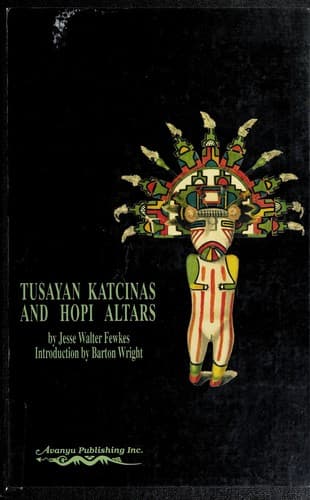
Any one who has studied the ceremonial system of the Tusayan Indians
will have noticed the predominance of great ceremonials in winter.
From harvest time to planting there is a succession of celebrations of
most complicated and varied nature, but from planting to harvesting
all these rites are much curtailed. The simplest explanation of this
condition would be, and probably is, necessity. There is not time
enough to devote to great and elaborate ceremonials when the corn must
be cared for. Time is then too precious, but when the corn is high and
the crop is in sight, or during the long winter when the agriculturist
is at home unemployed, then the superstitious mind has freedom to carry
on elaborate rites and observances, and then naturally he takes part
in the complex ceremonies. Hence the spring and early summer religious
observances are abbreviated. Although the Pueblo farmer may thoroughly
believe in his ceremonial system as efficacious, his human nature is
too practical to consume the precious planting time with elaborate
ceremonials. But when he sees that the crop is coming and harvest is at
hand, then he begins the series of, to him, magnificent pageants which
extend from the latter part of August until March of the following year.
It has been proven by repeated observations of the same ceremonials
that there is great constancy in the way successive presentations
of the ritual are carried out year after year. The inevitable
modifications resulting from the death of old priests undoubtedly in
course of time affect individual observances, but their ritual is never
voluntarily changed. The ceremonials which I have here and elsewhere
described were not invented by them to show to me, nor will any
religious society of the Hopi at the present day get up a ceremony to
please the white man. Each observance is traditional and prescribed for
a certain time of the year.
TABULAR VIEW OF THE SEQUENCE OF TUSAYAN CELEBRATIONS[7]
The following tabular view of the sequence of ceremonials may aid in
the study of the Hopi calendar, and indicate the ceremonials presented
to us for classification:
{ Katcina’s return.
_A_[8] { Powámû.
{ Pálülükoñti.
The abbreviated Katcinas commonly come in the interval, and vary
somewhat from year to year.
{ Nimán (Katcina’s departure).
{ Snake or Flute (alternating).
{ Lálakoñti.
_B_ { Mamzraúti.
{ Wüwütcímti[9] (sometimes Naácnaiya).
{ Soyáluña.
_Masked or Katcina Ceremonials_
Public-domain text, read in full here on John Shaqi.
Reviews
Reviews
No reviews yet
Be the first to share your thoughts on this work.
Join the Discussion
Join the discussion
Sign in to leave a comment or review.
Sign InorCreate an account