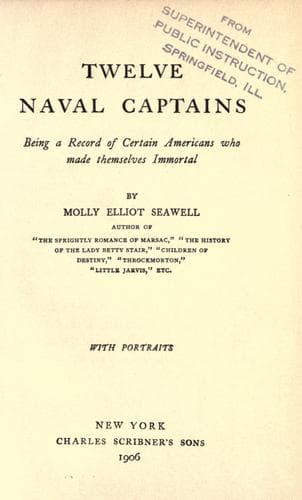
Twelve Naval Captains: Being a Record of Certain Americans Who Made Themselves ImmortalSeawell, Molly Elliot
History
Twelve Naval Captains: Being a Record of Certain Americans Who Made Themselves Immortal
Seawell, Molly Elliot
United States. Navy -- Biography
The captain, seeing nothing was to be got out of the resolute young
lieutenant, left the ship, but was pulled toward the merchant ship.
Macdonough had a boat lowered which followed the British boat, watching
her until she returned to the frigate. This action not only won the
good opinion of the captain and other officers and men of the Siren,
but of many of the British officers as well, who knew how to respect a
man of such resolute courage.
Macdonough was ever afterward treated with the utmost consideration
and politeness by all the British officers at Gibraltar, including the
officers of the overbearing captain.
At the outbreak of the war with Great Britain Macdonough was what was
then termed a master commandant. His was not the fortune of Decatur,
Stewart, and others of his brave shipmates to seek for glory on the
wide ocean, but he was sent into the wilderness, as it were, to create
a navy, and to fight the British on the great lakes. He established
himself with his seamen and workmen on the shores of Lake Champlain,
and began immediately the construction of a fleet. Officers and men
worked with the greatest ardor, and the commodore, as Macdonough was
now called by courtesy, might often have been seen handling the saw and
plane. A corvette, called the Saratoga, and meant for the commodore's
flagship, was begun, with several smaller vessels; and so rapidly did
they advance that only a few weeks from the time the trees were cut
down in the forest the vessels were launched and being made ready for
their guns. These had to be dragged many hundreds of miles through
a pathless wilderness, such as the northern and western part of New
York was then. It was difficult, but still it could be done. When it
came to transporting the cables, though, a point was reached, about
forty miles from the lake shore where the vessels were building, when
it seemed impossible to move a step farther. There were no roads, and
the cables had been brought in ox-wagons, which now came to a complete
standstill. No one knew what to do until an old sailor proposed that
they should stretch each cable its whole length, and men, stationed ten
yards apart, should shoulder it and carry it the forty miles remaining;
and this was actually done.
Meanwhile the British had not been idle, and they too, on the other
side of the lake, had built a frigate, called the Confiance, that
was heavier than the Saratoga, and they had other smaller vessels.
Their commanding officer, Captain Downie, was a worthy antagonist of
Commodore Macdonough, and about the same age, while the British vessels
were manned by seasoned sailors, many of whom had served under Nelson
and Collingwood.
Public-domain text, read in full here on John Shaqi.
Reviews
Reviews
No reviews yet
Be the first to share your thoughts on this work.
Elsewhere in the archive
Join the Discussion
Join the discussion
Sign in to leave a comment or review.
Sign InorCreate an account