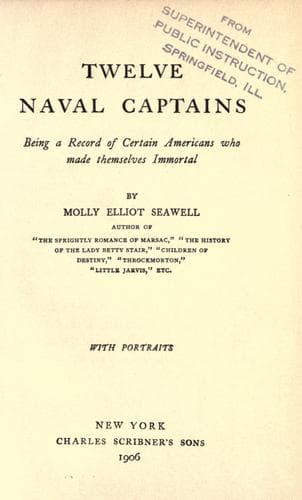
Twelve Naval Captains: Being a Record of Certain Americans Who Made Themselves ImmortalSeawell, Molly Elliot
History
Twelve Naval Captains: Being a Record of Certain Americans Who Made Themselves Immortal
Seawell, Molly Elliot
United States. Navy -- Biography
Early in September, 1814, both squadrons being ready to fight,
Commodore Macdonough chose his position with a seaman's eye, in
Plattsburg bay. He knew that his enemy would hunt for him wherever he
might be, and he chose to fight at anchor, rightly supposing that the
British, through their greater experience, could conduct the evolutions
of a squadron better than the Americans; for, while none could be more
daring in action than Macdonough, none was more prudent beforehand. The
exact knowledge he had of the elements for and against him explains
much of his success.
On the night of the 9th of September, in the midst of storm and
tempest, the American squadron made its way up the lake to Plattsburg
harbor. The next morning saw it anchored in the admirable order devised
by Commodore Macdonough's genius. The flagship, Saratoga, the heaviest
ship in the squadron, was in the middle of the line. Ahead of her was
ranged the gun-brig Eagle, commanded by Captain Cassin, who had been
one of Commodore Preble's midshipmen with Macdonough, eleven years
before. The Eagle had shoal water off her beam, so that the head of
the line could not be turned. On the other side of the Saratoga was
the Ticonderoga, a small sloop-of-war, while beyond her was the little
Preble, named for the great commodore, who was no more. There were,
besides, ten small gunboats, of which the Eagle was supported by two,
the Saratoga by three, the Ticonderoga by two, while the remaining two
were to assist the Preble in defending the end of the line. All of the
vessels were riding easily at anchor, and all of them were provided
with springs to their anchors and kedges, to enable them to change
their position at will. The wisdom of this precaution was shown on the
great day for which they were prepared.
On the 11th of September, 1814, a brilliant Sunday morning, just
at sunrise, the dazzling white topsails of the British fleet were
seen passing along the neck of land called Cumberland Head, which
juts into the bay. The American guard-boat pulled in, all hands were
called to quarters in the American squadron, and an American ensign
was set at every masthead. Then on board the flagship was made the
signal for divine service, and Commodore Macdonough, kneeling upon his
quarterdeck, surrounded by his officers and in hearing of his men, with
every head bared, read the prayers appointed to be read before a fight
at sea. After this brief but solemn act all awaited the onset with
steadiness and cheerfulness.
It had been suggested to him that he should issue an extra allowance of
grog to the men, but he replied,--
"No. My men shall go cool into action; they need no stimulant beyond
their native valor."
The American vessels were so skilfully moored that no matter from what
quarter the wind was, the British were obliged to approach them "bows
on," a very dangerous way to attack a bold and skilful enemy.
Public-domain text, read in full here on John Shaqi.
Reviews
Reviews
No reviews yet
Be the first to share your thoughts on this work.
Elsewhere in the archive
Join the Discussion
Join the discussion
Sign in to leave a comment or review.
Sign InorCreate an account