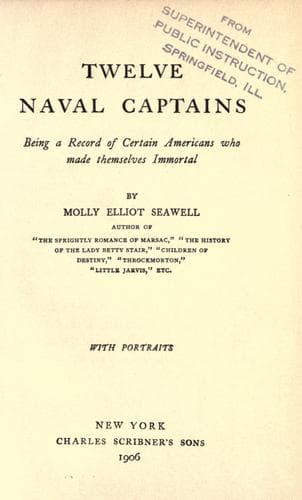
Twelve Naval Captains: Being a Record of Certain Americans Who Made Themselves ImmortalSeawell, Molly Elliot
History
Twelve Naval Captains: Being a Record of Certain Americans Who Made Themselves Immortal
Seawell, Molly Elliot
United States. Navy -- Biography
By that time the Finch had been driven out of the fight, and the Chubb
had been shot wholly to pieces. The little Linnet, though, alone and
single-handed, undauntedly sustained the fight, hoping that some of
the gunboats might be able to tow her off. But when the Saratoga had
finished with the Confiance, without a moment's loss of time, she
turned her broadside on the Linnet, and soon forced her to strike,
with her hull riddled like a sieve, her masts gone, and the water
a foot deep in her hold. By midday all was over, and of the sixteen
British ensigns that had fluttered proudly in the morning air, not one
remained. It was one of the most destructive naval engagements ever
fought. In Commodore Macdonough's official report, he says there was
not a mast left in either squadron on which sail could be made. Some
of the British sailors had been at Trafalgar, and they all agreed that
the fighting of that 11th of September had been more severe than at
Trafalgar.
The American sailors fought with extraordinary coolness, and many
amusing as well as terrible and inspiring things occurred. One old
sailor on the Saratoga, who had worked and fought all during the battle
and had been slightly wounded several times, was seen mopping his face
delightedly while calling out to one of his messmates, "Ay, Jack, this
is the best fun I've had this war."
Another, getting a shot through his glazed hat, took it off, and,
turning to an officer, said in a tone of bitter complaint, "Look
a-here, sir; them Johnny Bulls has spiled my hat. Now, what am I going
to do for a hat?"
As soon as the Linnet struck, the British officers, led by Captain
Pring, who succeeded Captain Downie in command, came aboard the
Saratoga to deliver their swords. All the American officers were
assembled on her quarterdeck, and as the British officers approached
Commodore Macdonough with their swords extended, he said, with deep
feeling,--
"Gentlemen, your gallant conduct makes you the more worthy to wear your
swords. Return them to their scabbards."
At once every attention was given the wounded, the officers working
side by side with the men. Captain Pring, in his report, says:--
"I have much satisfaction in making you acquainted with the humane
treatment the wounded have received from Commodore Macdonough. They
were immediately removed to his own hospital at Crab Island, and
furnished with every requisite. His generous and polite attention to
myself, the officers, and men, will ever be gratefully remembered." All
this was quite characteristic of Macdonough, who united the tenderness
of a woman with a lion-like courage.
The night of the battle the commodore visited every ship in the
squadron, and personally expressed to the officers and men his
appreciation of their gallant services that day.
Public-domain text, read in full here on John Shaqi.
Reviews
Reviews
No reviews yet
Be the first to share your thoughts on this work.
Elsewhere in the archive
Join the Discussion
Join the discussion
Sign in to leave a comment or review.
Sign InorCreate an account