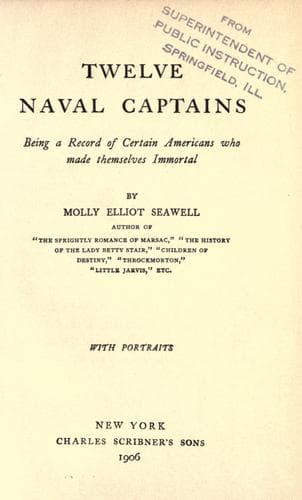
Twelve Naval Captains: Being a Record of Certain Americans Who Made Themselves ImmortalSeawell, Molly Elliot
History
Twelve Naval Captains: Being a Record of Certain Americans Who Made Themselves Immortal
Seawell, Molly Elliot
United States. Navy -- Biography
The news of the victory was received all over the country with
manifestations of joy. Congress passed the usual resolution of thanks
to Macdonough, his officers and men, gave him and his two commanding
officers gold medals, silver medals to the lieutenants, and a handsome
sword to each of the midshipmen, with a liberal award of prize money
to the men. Macdonough was made a post-captain, his commission dating
from the day of the battle.
The State of Vermont gave him an estate overlooking the scene of his
victory, and many States and towns made him presents. Macdonough bore
all these honors with characteristic modesty and simplicity, and,
instead of being elated by them, tears came into his eyes in speaking
of what his country had bestowed upon him.
Soon after this peace was declared, and Macdonough returned again to
service on the ocean. His health had always been delicate, and as years
passed on, it grew more so. But he continued to go to sea, and did his
full duty as always. In 1825 he was in command of the glorious old
Constitution, as his flagship on the Mediterranean station. She had
been splendidly refitted, sailed admirably, both on and off the wind,
and, as the sailors said, "looked like a new fiddle." He made his last
cruise in this noble ship. His health rapidly declined, and on his way
home from the Mediterranean he died and was buried at sea on the 10th
of November, 1825.
Few men have enjoyed more national esteem and affection than
Macdonough. His career shows that a man may have the softest manners
and mildest disposition along with an invincible courage and a high
spirit. Macdonough may be taken as the type of a great seaman and a
pure and perfect man.
JAMES LAWRENCE.
The name of Lawrence, like that of Somers, is associated with youth,
with gallantry, and with misfortune. It was his fate, after many
brilliant and heroic successes, to lay down his life and lose his ship;
but his colors were hauled down, not by himself, but by the enemy, and
his last utterance, "Don't give up the ship," which has become the
watchword of the American navy, was literally obeyed. It is remarkable
that this unfortunate vessel, the Chesapeake, never was formally
surrendered, but was taken possession of and her flag struck by her
captors.
[Illustration: James Lawrence]
Public-domain text, read in full here on John Shaqi.
Reviews
Reviews
No reviews yet
Be the first to share your thoughts on this work.
Elsewhere in the archive
Join the Discussion
Join the discussion
Sign in to leave a comment or review.
Sign InorCreate an account