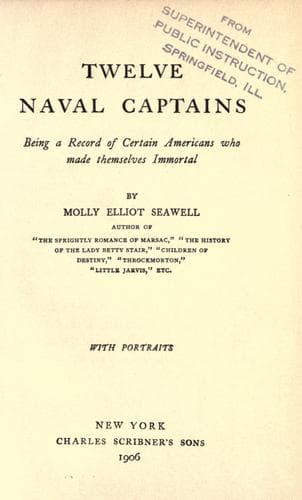
Twelve Naval Captains: Being a Record of Certain Americans Who Made Themselves ImmortalSeawell, Molly Elliot
History
Twelve Naval Captains: Being a Record of Certain Americans Who Made Themselves Immortal
Seawell, Molly Elliot
United States. Navy -- Biography
The crew was made up of men of all nationalities, including a number
of Malays, and many of the fok'sle people did not understand the word
of command. With this singular squadron and unpromising ship and crew
Paul Jones set sail on the 15th of August, under orders to report at
the Texel early in October. Great things were expected of him, but
agonizing disappointment seemed to be in store for him. Landais, the
captain of the Alliance, was mutinous, and the whole squadron seemed
incapable of either acting together or acting separately. Twice Paul
Jones sailed up the Firth of Forth as far as Leith, the port of
Edinburgh, and the Edinburghers made preparations to withstand this
bold invader. Among the children who lay awake at night waiting for the
booming of Paul Jones's guns, was a lad of ten years of age,--Walter
Scott, who, when he was the great Sir Walter, often spoke of it. But
both times the wind blew Paul Jones out to sea again, so that nothing
was done in the way of a descent on Edinburgh. Many merchant ships
were taken, and the coasts of the three kingdoms were alarmed, but
so far no enemy in the shape of a warship had appeared. The time for
the cruise to be up was fast approaching, and it seemed likely to end
in a manner crushing to the hopes of Paul Jones, when, at noon on the
23d of September, 1779, the Bon Homme Richard being off Flamborough
Head, a single ship was seen rounding the headland. It was the first
of forty ships comprising the Baltic fleet of merchantmen, which Paul
Jones had expected and longed to intercept. A large black frigate and a
smaller vessel were convoying them; and as soon as the two warships had
placed themselves between the fleet and the Bon Homme Richard, all the
fighting ships backed their topsails and prepared for action.
At the instant of seeing the two British ships, Paul Jones showed
in his air and words the delight his warrior's soul felt at the
approaching conflict. His officers and crew displayed the utmost
willingness to engage, while on board the Serapis her company asked
nothing but to be laid alongside the saucy American.
The Serapis was a splendid new frigate,--"the finest ship of her class
I ever saw," Paul Jones afterward wrote Dr. Franklin,--and carried
fifty guns. It is estimated that her force, as compared to the poor
old Bon Homme Richard, was as two to one. She was commanded by Captain
Pearson, a brave and capable officer. At one o'clock the drummers beat
to quarters on both ships, but it was really seven o'clock before they
got near enough to begin the real business of fighting. Much of this
time the British and Americans were cheering and jeering at each other.
The Serapis people pretended they thought the Bon Homme Richard was
a merchant ship, which indeed she had been before she came into Paul
Jones's hands, and derisively asked the Americans what she was laden
with; to which the Americans promptly shouted back, "Round, grape, and
double-headed shot!"
Public-domain text, read in full here on John Shaqi.
Reviews
Reviews
No reviews yet
Be the first to share your thoughts on this work.
Join the Discussion
Join the discussion
Sign in to leave a comment or review.
Sign InorCreate an account