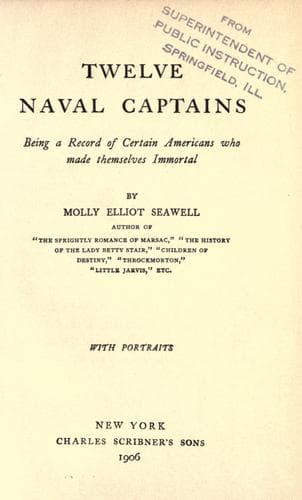
Twelve Naval Captains: Being a Record of Certain Americans Who Made Themselves ImmortalSeawell, Molly Elliot
History
Twelve Naval Captains: Being a Record of Certain Americans Who Made Themselves Immortal
Seawell, Molly Elliot
United States. Navy -- Biography
There was much hard work to be done by every officer in the squadron
before it was ready to attack Tripoli in August, 1804, and Lawrence, as
first lieutenant, did his part. Once before Tripoli, there was severe
fighting as well as hard work. The fact that Decatur was taken out of
his ship so often to lead a division of the boats, left the command of
the Enterprise much to Lawrence, and he handled the little schooner in
the most seamanlike manner.
In the winter of 1804-5 the government determined to build a number
of small gunboats, to renew the attacks on Tripoli in the summer.
Some of the lieutenants who had returned to the United States in the
changes necessary in the squadron, were selected to take them out to
the Mediterranean. Lawrence, who had come back to the United States
after spending two years in the Mediterranean, was given the command
of one of these little vessels, Number Six,--for they were thought to
be too insignificant to name and consequently were merely numbered.
They carried a large spread of canvas, but their gunwales were so near
the water that they looked rather like rafts than boats. On the way
over, Lawrence was sighted by the British frigate Lapwing, which sent a
boat to rescue them, supposing them to be on a raft after a shipwreck.
Lawrence thanked the officer in charge of the boat, but proceeded on
his way.
Commodore Rodgers was then in command of the American force which again
appeared before Tripoli in May, 1805; and without firing a gun a treaty
of peace and the release of the Philadelphia's officers and men were
secured. The squadron then sailed for Tunis, where it intimidated the
Tunisians into good behavior and negotiated a treaty of peace under the
threat of a bombardment.
Soon after most of the vessels returned home. Lawrence recrossed the
ocean again in his gunboat, and commanded her for some time after.
On the 22d of June, 1807, occurred the painful and mortifying
rencounter of the Chesapeake, frigate, with the British frigate
Leopard, one of the most far-reaching events in the American navy.
As the name of Lawrence will ever be connected with the unfortunate
Chesapeake, the story of that unhappy event can be told here.
The Chesapeake was a comparatively new ship, carrying thirty-eight
guns, and was put in commission to relieve the Constitution in the
Mediterranean. She seems to have been an unpopular ship from the first,
as she was thought to be weak for her size, and was a very ordinary
sailer. She was to wear the broad pennant of Commodore James Barron,
who had Captain Gordon as his flag captain. Both of these men were
esteemed excellent officers.
Public-domain text, read in full here on John Shaqi.
Reviews
Reviews
No reviews yet
Be the first to share your thoughts on this work.
Elsewhere in the archive
Join the Discussion
Join the discussion
Sign in to leave a comment or review.
Sign InorCreate an account