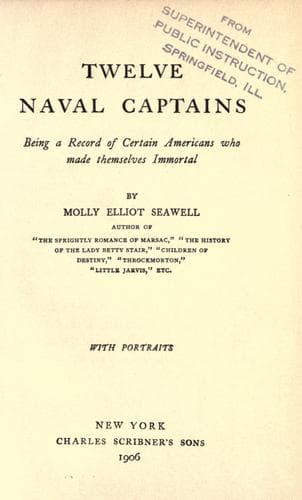
Twelve Naval Captains: Being a Record of Certain Americans Who Made Themselves ImmortalSeawell, Molly Elliot
History
Twelve Naval Captains: Being a Record of Certain Americans Who Made Themselves Immortal
Seawell, Molly Elliot
United States. Navy -- Biography
The Chesapeake was fitted partly at the Washington Navy Yard and partly
at the Norfolk Navy Yard. There had been a charge that she had among
her crew three deserters from the British frigate Melampus. The charge
had been investigated, however, and found to be a mistake. It was known
that the Leopard, of fifty guns, was hanging about outside the capes of
Virginia, but it was not suspected that she would attempt to stop the
Chesapeake. The British government, arrogant in its dominion over the
sea, had claimed and exercised the right of searching merchant vessels;
and the United States, a young nation, with a central government which
was still an experiment as well as an object of jealousy to the State
governments, had submitted from not knowing exactly how to resist. But
with a ship of war it was different, and neither the authorities nor
the people of the United States dreamed that any attempt would be made
to violate the deck of a national vessel.
There seems to have been great negligence in preparing the Chesapeake
for sea, and when she sailed she was in a state of confusion, her decks
littered up, and none of the apparatus used in those days for firing
great guns was available. Neither was her crew drilled, having been at
quarters only three times. Her officers were men of spirit, but there
seems to have been a fatal laxness in getting her ready for sea.
The Chesapeake, with a good wind, dropped down to Hampton Roads, and
was soon stretching out to sea. About noon the Leopard was discerned,
and from the first seemed to be following the Chesapeake. At three
o'clock the two, still making for the open ocean, were near enough to
speak, and the Leopard hailed, saying she had despatches for Commodore
Barron. This was not remarkable, as such courtesies were occasionally
exchanged between ships of friendly nations. The Chesapeake hove
to, as did the Leopard, close to each other, when the Chesapeake's
officers noticed that the British frigate had her guns run out, and was
evidently perfectly ready for action. Very soon a boat put off from
her, and a lieutenant came aboard the Chesapeake. He went below into
the great cabin, and handed Commodore Barron a letter from Vice-Admiral
Berkley, dated at Halifax, directing him on meeting the Chesapeake to
search her for the three alleged deserters, and offering to allow the
Leopard to be searched if desired.
Commodore Barron was a brave man and a good officer in general, but he
appears to have been seized with one of those moments of indecision
which in a few minutes can wreck a whole life. It is difficult, though,
to imagine how one could act judiciously in an emergency so terrible,
when the choice lies between submitting to a frightful insult and
provoking a conflict which must result in the loss of many gallant and
innocent men. The commodore's real fault was in going to sea in an
unprepared condition.
Public-domain text, read in full here on John Shaqi.
Reviews
Reviews
No reviews yet
Be the first to share your thoughts on this work.
Elsewhere in the archive
Join the Discussion
Join the discussion
Sign in to leave a comment or review.
Sign InorCreate an account