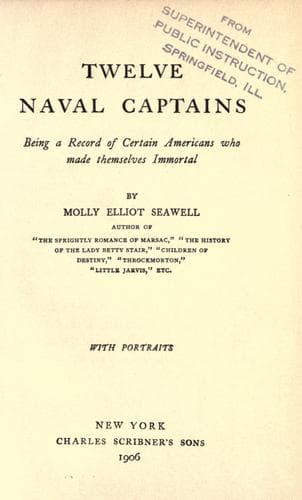
Twelve Naval Captains: Being a Record of Certain Americans Who Made Themselves ImmortalSeawell, Molly Elliot
History
Twelve Naval Captains: Being a Record of Certain Americans Who Made Themselves Immortal
Seawell, Molly Elliot
United States. Navy -- Biography
Lawrence treated his prisoners with characteristic generosity, and his
example was not lost on his men. The Peacock's crew had lost everything
by the sinking of the ship, and the Hornet's men took up a subscription
among themselves to provide each of the prisoners with two shirts, a
blue jacket, and trousers.
Finding himself crowded with prisoners, Lawrence stood for home, and
arrived at New York late in March, 1813. The officers of the Peacock,
on being paroled at New York, addressed him a very handsome letter of
thanks, in which they said, "We cannot better express our feelings than
by saying that we ceased to consider ourselves prisoners."
The city of New York, anticipating the thanks of Congress, and the gold
medal for Lawrence, with prize money for the crew, gave Lawrence the
freedom of the city and a handsome piece of plate. On the 6th of April
a great dinner was given at Washington Hall, then a splendid place of
entertainment in New York, to Lawrence and his officers, while in the
ball-room of the building the petty officers, sailors, and marines
of the Hornet were entertained. The sailors landed at Whitehall, and
with music playing, marched up Pearl Street, Wall Street, and Broadway
to Washington Hall amidst the greatest enthusiasm on the part of the
inhabitants. After a fine dinner Captain Lawrence and his officers,
accompanied by the members of the city government of New York, visited
them, and the party was received by the sailors rising and giving
three times three for their commander. The whole body of sailors was
afterward invited to occupy the pit at the theatre, with Lawrence and
his officers and their hosts in the boxes. The audience cheered the
sailors vociferously, and the sailors seem to have cheered everything;
and they were highly pleased with their entertainment.
This was the last glimpse of brightness in Lawrence's short life. He
had a prospect of getting the Constitution, but his hopes were dashed
by being ordered to command the Chesapeake, then fitting at Boston.
The ship had become more and more an object of dislike in the navy
since her unfortunate experience in 1807. Sailors hated her, and would
not enlist in her if they could help it. No officer would serve in
her if he could get any other ship; consequently she was officered by
juniors who had to take her because they could do no better. She had
lately returned from a cruise in which she had sailed many thousands of
miles, under an active and enterprising captain, without once meeting
a chance to distinguish herself, and capturing only a few trifling
prizes. Lawrence was dismayed at the offer of this command. He begged
to remain in the Hornet rather than go to the Chesapeake. He told his
friends that the frigate was a worthless ship, and he would not have
her if he could honorably refuse; but this he could not do. In May,
1813, he took command of her. Up to the last moment he hoped to be
relieved by Captain Stewart, but it was not to be.
Public-domain text, read in full here on John Shaqi.
Reviews
Reviews
No reviews yet
Be the first to share your thoughts on this work.
Elsewhere in the archive
Join the Discussion
Join the discussion
Sign in to leave a comment or review.
Sign InorCreate an account