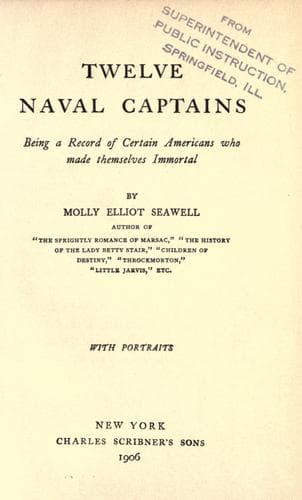
Twelve Naval Captains: Being a Record of Certain Americans Who Made Themselves ImmortalSeawell, Molly Elliot
History
Twelve Naval Captains: Being a Record of Certain Americans Who Made Themselves Immortal
Seawell, Molly Elliot
United States. Navy -- Biography
The Hornet and the Essex, under Captain Porter, were ordered to
cruise with Captain Bainbridge in the Constitution. But after getting
out from Boston in October, 1812, and cruising a few weeks with the
Constitution, they separated. The Hornet, being off San Salvador,
challenged the Bonne Citoyenne, a vessel of about her own strength,
to come out and fight. As the Bonne Citoyenne had a large amount of
specie on board which her captain was under orders to deliver, he
very properly declined to fight, and was blockaded by the Hornet for
nearly three weeks. The Montagu, ship of the line, appearing however,
Captain Lawrence thought it time to be off, and managed to slip out to
sea in the darkness of an autumn night. He cruised some time, taking
a few prizes, and on the 24th of February came in sight of a large
man-of-war brig, the Peacock. She was called "the yacht" from the
beautiful brightness and order in which she was kept, and was commanded
by Captain Peake, a gallant and skilful officer. The Peacock showed a
perfect willingness to fight, and the two vessels stood for each other
at once. About five o'clock, being very near each other, their ensigns
were hoisted, and the battle began by exchanging broadsides as they
passed. After one or two rounds the Hornet came down, her batteries a
sheet of flame, and her fire frightfully destructive to her adversary.
The Peacock stood the blast of fire a very short time, fifteen minutes
being the longest time estimated,--Lawrence afterward said it was
eleven minutes by his watch, but, his clerk having put it down fifteen
minutes, he allowed it to stand,--when the Peacock lowered her colors
and displayed signals of distress in her forerigging. She was in a
sinking condition, when a prize crew was thrown aboard; and in spite
of every effort on the part of the officers and men of the Hornet, the
Peacock went down, carrying nine of her own people and three of the
Hornet's. The prize-master of the Hornet and his boat's crew saved
themselves with difficulty in the launch.
The Peacock was well handled and fought by her commander, who lost his
life in the engagement. But the Hornet was so skilfully manoeuvred,
and her gunnery, besides being extremely accurate, was so rapid, that
she had the advantage from a few minutes after the beginning of the
combat. She was slightly superior to the Peacock both in men and metal,
but the damage she did was far beyond the small difference of strength
between her and her antagonist. When the Peacock surrendered, her
mainmast had gone by the board, her hull was riddled, and she had six
feet of water in her, which soon carried her to the bottom; while, by
nine o'clock that night, every injury to the Hornet had been repaired,
and she was ready to go into action again.
Public-domain text, read in full here on John Shaqi.
Reviews
Reviews
No reviews yet
Be the first to share your thoughts on this work.
Elsewhere in the archive
Join the Discussion
Join the discussion
Sign in to leave a comment or review.
Sign InorCreate an account