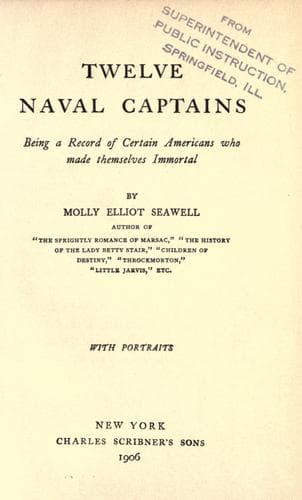
Twelve Naval Captains: Being a Record of Certain Americans Who Made Themselves ImmortalSeawell, Molly Elliot
History
Twelve Naval Captains: Being a Record of Certain Americans Who Made Themselves Immortal
Seawell, Molly Elliot
United States. Navy -- Biography
Bainbridge was very doubtful whether his vessel would be allowed to
pass the Dardanelles, as the American flag had never been seen in those
seas before; so he concluded to get through by his wits. He approached
with a strong wind, and clewed up his light sails as if about to
anchor, saluting meanwhile. The salute was returned, and under cover
of the smoke sail was quickly made and the ship slipped past, out of
range of shot from the castles. When she reached Constantinople, a boat
was sent ashore to report her arrival. The Turkish officials sent back
word that they knew no such nation as the United States. They were
soon convinced that there was such a nation, and were well received.
The Sultan's brother-in-law, Capudan Pasha, became much attached to
Bainbridge, and mentioned that the Dey of Algiers was not in favour
with the Sublime Porte. Bainbridge, knowing he would return to Algiers,
got a letter from Capudan Pasha, in which the Dey was commanded to
treat the American commander with the highest respect. Bainbridge
returned to Algiers in January, and was immediately met with another
demand,--that he take the Algerine ambassador back to Constantinople.
This he firmly refused, at an interview in which the Dey stormed,
raged, and threatened. In the midst of this, Bainbridge calmly produced
Capudan Pasha's letter. The Dey paused, grew pale, and trembled, and
then burst into profuse offers of assistance, which Bainbridge coolly
declined, and left the palace.
The next day, in obedience to orders from Constantinople, the Dey
declared war against France, and notified all of the French in
Algiers--fifty-six men, women, and children--that unless they left
within forty-eight hours, they would be sold into slavery. France was
then at war with the United States, but this did not prevent Bainbridge
from offering these unfortunates an asylum on the George Washington at
great inconvenience to himself, and carrying them all to Spain. For
this humane act he received the personal thanks of Napoleon Bonaparte,
then First Consul.
Bainbridge returned to the United States with the George Washington,
and soon after got the Essex, a thirty-two-gun frigate attached to
the squadron which was sent to the Mediterranean in 1801, under the
command of Commodore Richard Dale. Among the lieutenants of the Essex
was Stephen Decatur, afterward the celebrated Commodore.
The ship arrived at Barcelona in August, and took a berth in the
harbor, close to the Spanish guardship. The neatness of the Essex and
the seamanlike appearance and conduct of her officers and men were so
much remarked upon that it gave great offence to the officers of the
guardship. The stay of the American frigate at Barcelona was a long
scene of turmoil, owing to collisions between her junior officers and
the Spanish midshipmen. In one of these Decatur figured prominently.
Bainbridge acted with spirit and also with judgment, but was glad to
get away from such uncomfortable quarters.
Public-domain text, read in full here on John Shaqi.
Reviews
Reviews
No reviews yet
Be the first to share your thoughts on this work.
Join the Discussion
Join the discussion
Sign in to leave a comment or review.
Sign InorCreate an account