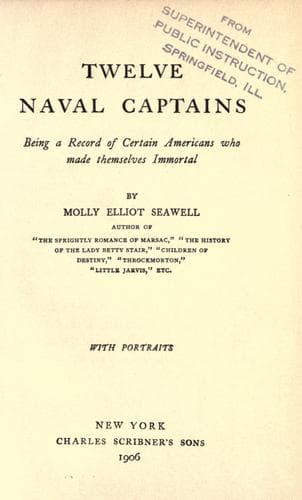
Twelve Naval Captains: Being a Record of Certain Americans Who Made Themselves ImmortalSeawell, Molly Elliot
History
Twelve Naval Captains: Being a Record of Certain Americans Who Made Themselves Immortal
Seawell, Molly Elliot
United States. Navy -- Biography
At once every effort was made to get the ship off, but she held fast,
and soon heeled over so far to starboard that her guns on that side
became useless. The Tripolitans at once saw her desperate plight, and
gunboats came out in swarms to attack her. The Americans fought the
gunboats off as best they could, meanwhile working with amazing energy
to save the ship. All the water in her was pumped out, the anchors were
cut from the bows, most of her guns thrown overboard, and at last the
foremast was cut away. Still the ship stuck fast. Bainbridge, who had
shown great coolness and determination in the dreadful circumstances in
which he found himself, presently saw that he must give up the ship.
He called a council of his officers, and they agreed that all had been
done that men could do. The carpenters were ordered to scuttle the
ship; and just as the autumn night was closing in, the Philadelphia's
colors were hauled down, and the Tripolitans swarmed over the decks, in
the ports, and everywhere a foot could be set. Then looting began; the
officers being robbed of everything, even their swords and epaulets.
Bainbridge gave up his watch and money in dignified silence; but when
his wife's picture was about to be torn from around his neck, he swore
no man should have it, and fought the Tripolitan off who would have
taken it.
The officers and men were then carried into the town, where the
officers were received by the Bashaw in great state, surrounded by
his ministers. It is said that Bainbridge never looked handsomer or
more imposing than when he appeared at the head of his officers before
the barbaric prince. The Bashaw treated them with Eastern courtesy,
gave them a handsome supper, for they were half dead with hunger and
fatigue, and then sent them to a temporary prison. They were in charge
of Sidi Mohammed D'Ghies, one of the great officers of state, who
proved to be a man of good heart, and whose ideas of military honor
were Western rather than Eastern.
Then began a captivity which lasted for nineteen months. The men were
reduced to a position of slavery, and made to work for their Tripolitan
masters. The officers were closely confined, and after several attempts
at escape had been made by the younger ones, they were removed to the
dungeons of the Bashaw's castle.
Public-domain text, read in full here on John Shaqi.
Reviews
Reviews
No reviews yet
Be the first to share your thoughts on this work.
Join the Discussion
Join the discussion
Sign in to leave a comment or review.
Sign InorCreate an account