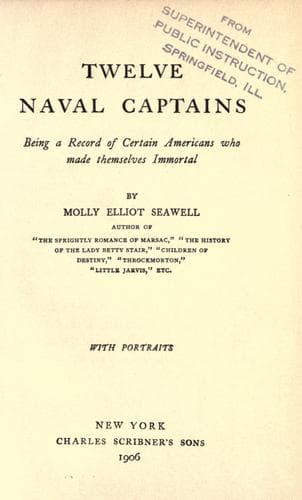
Twelve Naval Captains: Being a Record of Certain Americans Who Made Themselves Immortal — John Shaqi
Twelve Naval Captains: Being a Record of Certain Americans Who Made Themselves ImmortalSeawell, Molly Elliot
History
Twelve Naval Captains: Being a Record of Certain Americans Who Made Themselves Immortal
Seawell, Molly Elliot
United States. Navy -- Biography
The captives were allowed to communicate at intervals with Commodore
Preble, who gave them assurance that they were not forgotten, and that
the Bashaw would have to surrender them and pay dearly for having
imprisoned them. Besides these official communications, means were
found by which letters written in lemon juice were exchanged, and in
one of these Bainbridge suggested the possibility of destroying the
Philadelphia at her moorings,--which was afterward carried out with
splendid dash by Decatur.
In spite of those alleviations, there were long months of weariness and
dreariness in a peculiarly trying captivity. The time was not wholly
wasted. The midshipmen, whose untamed spirits frequently got them
into difficulties, were set to work by the older officers, and all,
men as well as officers, bore their imprisonment with fortitude. The
seamen were made to labor on the fortifications; and as they were often
unruly, the slave-drivers had no hesitation in ordering them to be
bastinadoed on every occasion. The man who administered the punishment
was not so hard-hearted as his masters, and although he regularly laid
on the required number of blows upon the soles of the sailors' feet, he
winked at the fact that they had wrapped folds of matting around their
feet, and the blows hurt not at all. The sailors were clever enough to
shriek and scream during this mock bastinadoing, and the slave-drivers
were completely deceived by Jack's ruse.
At last, on the night of the 15th of February, 1804, the captives were
awakened by the firing of heavy guns. By the light of a brilliant moon
and the blazing hull and spars of the Philadelphia out in the harbor,
they saw the destruction of the ship by Decatur[2] and his gallant
band. While they watched her burn to the water's edge, her shotted guns
burst with heat and flame, her magazine blew up, and when the sun rose
next morning, not a vestige remained of the lovely frigate. She had
been destroyed by the Americans under Decatur, without the loss of a
single man.
This gave heart to the prisoners, and they felt their deliverance was
at hand; but it was not until the spring had passed and the summer
dragged along into August that one day they were roused by a heavy
cannonade. They were then confined underground in the Bashaw's castle,
and there was only one window by which they could see the offing. They
eagerly clambered up, and the thrill of joy they felt may be imagined
when they saw a smart flotilla of small vessels, led with the greatest
dash and impetuosity by Decatur and Somers, burning, sinking, or
driving back the Tripolitan gunboats. And farther out in the offing,
they saw the glorious Constitution coming into action in grand style,
choosing her range with majestic deliberation, and then her batteries
roaring out destruction to her enemies, while the Tripolitan shot fell
short, or dropped harmlessly against her stout sides.
Public-domain text, read in full here on John Shaqi.
Reviews
Reviews
No reviews yet
Be the first to share your thoughts on this work.
Join the Discussion
Join the discussion
Sign in to leave a comment or review.
Sign InorCreate an account