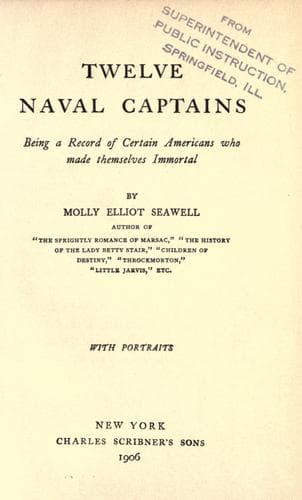
Twelve Naval Captains: Being a Record of Certain Americans Who Made Themselves ImmortalSeawell, Molly Elliot
History
Twelve Naval Captains: Being a Record of Certain Americans Who Made Themselves Immortal
Seawell, Molly Elliot
United States. Navy -- Biography
On the first outbreak of hostilities with the mother country Paul
Jones offered his services to the Continental Congress, and his name
headed the list of thirteen first lieutenants in the navy appointed
in December, 1775. Perhaps no man had stronger natural and personal
inclinations toward the revolutionary cause than Paul Jones. In his
native country he was poor, obscure, and perpetually barred out by his
low estate from those high places to which his vast ambition aspired.
In America, under a republican form of government, he was as good as
any man, provided only he were worthy; and the fixed rank of a naval
officer would give him standing in Europe among those very persons who
would otherwise have regarded him with contempt.
His commission was obtained through Mr. Joseph Hewes, a member of
Congress from North Carolina, and the celebrated Robert Morris, who was
then at the head of the Marine Committee of Congress. The influence of
Thomas Jefferson was also in his favor.
At this time his true career may be said to have begun. He was then
twenty-eight years old, of "a dashing and officer-like appearance,"
his complexion dark and weather-beaten, and his black eyes stern and
melancholy in expression. He had a slight hesitation in his speech
which disappeared under the influence of excitement. His manner with
sailors was said to be peculiarly winning, and he was, no doubt, highly
successful in dealing with those characters which can be gained by
kindness and indulgence; but with that part of mankind to whom severity
is a necessity, he does not seem to have been so well adapted, and the
evidences of a firm and consistent discipline are wanting. When he
came to command a ship of his own,--which he did very shortly,--he was
extremely polite to the midshipmen, frequently asking them to dine with
him in the cabin, but likely to blaze away at them if they were not
carefully and properly dressed for the occasion. One of his officers,
presuming upon Paul Jones's indulgence, ventured to be insolent, and
got himself kicked down the hatchway for it. It is said that when a
midshipman on the topgallant yard was inattentive to his duty as a
lookout, Paul Jones himself would gently let go the halyards, and the
unlucky midshipman would come down the yard on the run.
Paul Jones was extremely temperate in his habits, and was naturally
fond of order and decorum. He had fixed religious principles, and, like
Washington, he considered a chaplain a useful and even a necessary
officer. A letter of his is extant in which he says he would like a
chaplain on board who should be accommodated in the cabin, and always
have a seat at the cabin table, "the government thereof should be
entirely under his direction." He was a tireless student by night, his
days at sea being occupied, when cruising, by exercising his officers
and men in their duty.
Public-domain text, read in full here on John Shaqi.
Reviews
Reviews
No reviews yet
Be the first to share your thoughts on this work.
Join the Discussion
Join the discussion
Sign in to leave a comment or review.
Sign InorCreate an account