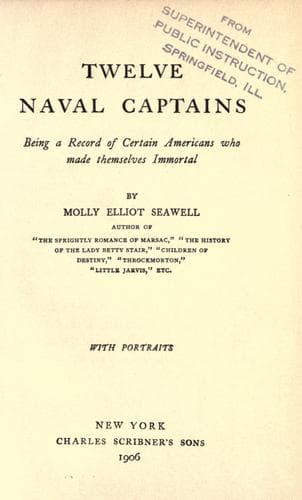
Twelve Naval Captains: Being a Record of Certain Americans Who Made Themselves ImmortalSeawell, Molly Elliot
History
Twelve Naval Captains: Being a Record of Certain Americans Who Made Themselves Immortal
Seawell, Molly Elliot
United States. Navy -- Biography
The younger officers were supplied with an endless fund of stories
about "the old man's" outbursts, and delighted in telling of one
especial instance which convulsed every officer and man on the
Constitution. A surgeon's mate was needed on the ship, and a little
Sicilian doctor applied for the place and got it. He asked the
commodore if he must wear uniform. To which the commodore replied,
"Certainly." Some days afterward the commodore happened to be in the
cabin, wearing his dressing-gown and shaving. Suddenly a gentleman
in uniform was announced. Now, in those days flag officers wore two
epaulets, the others but one, and the commodore himself was the only
man in the squadron who was entitled to wear two. But the stranger
had on two epaulets; besides, a sword, a cocked hat, and an enormous
amount of gold lace.
The commodore surveyed this apparition silently, puzzled to make out
who this imposing personage was, until, with a smirk, the bedizened
Sicilian announced himself as the new surgeon's mate. Furious at his
presumption in appearing in such a rig, Preble uttered a howl of rage,
which scared the little doctor so that he fled up on deck, closely
followed by the commodore, his face covered with lather, and the open
razor still in his hand. The little doctor ran along the deck, still
pursued by the commodore with the razor, until, reaching the forward
end of the ship, the poor Sicilian sprang overboard and struck out
swimming for the shore, and was never seen on the ship again.
Preble transferred his flag to the John Adams, and visited Gibraltar,
where he was received with distinction by the British officers. He had
many friends among them, especially Sir Alexander Ball, one of Nelson's
captains; and the great Nelson himself knew and admired the services of
the Americans before Tripoli. The Spaniards and Neapolitans, who had
suffered much from the corsairs, rejoiced at the drubbing Preble had
given them, and at the prospect that the Americans imprisoned in the
Bashaw's castle would soon be released. The Pope, Pius the Seventh,
said: "This American commodore has done more to humble the piratical
powers of the Barbary coast than all the Christian powers of Europe put
together."
Preble sailed for home in December, 1804, and reached Washington
the 4th of March, 1805, the day of President Jefferson's first
inauguration. The news of his success and the early release of the
Philadelphia's officers and men had preceded him. Congress passed a
vote of thanks to him and the officers and men under him. President
Jefferson, although of the opposite party in politics from Preble,
offered him the head of the Navy Department, but it was declined.
Preble's health had steadily grown worse, and soon after his return to
the United States it was seen that his days were few. He lingered until
the summer of 1807, when at Portland, Maine, near his birthplace, he
passed away, calmly and resignedly. He left a widow and one child.
Public-domain text, read in full here on John Shaqi.
Reviews
Reviews
No reviews yet
Be the first to share your thoughts on this work.
Elsewhere in the archive
Join the Discussion
Join the discussion
Sign in to leave a comment or review.
Sign InorCreate an account