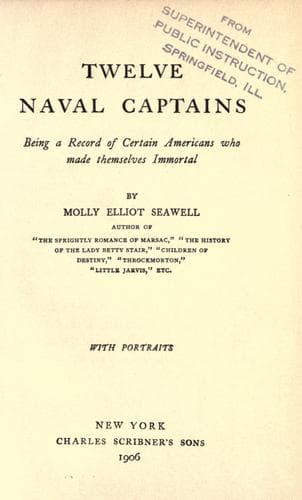
Twelve Naval Captains: Being a Record of Certain Americans Who Made Themselves ImmortalSeawell, Molly Elliot
History
Twelve Naval Captains: Being a Record of Certain Americans Who Made Themselves Immortal
Seawell, Molly Elliot
United States. Navy -- Biography
The nature of this enterprise required men of extraordinary steadiness
as well as courage; but they could be easily supplied from the American
squadron. It was intended to man and officer the Intrepid as far
as possible from the Enterprise; and in pursuance of this, on the
afternoon of the 3d of February, 1803, all hands on the Enterprise were
called up and aft. Decatur then stated the nature of the service for
which the Intrepid was destined,--a service of heroic possibilities
but appalling danger,--and then called for sixty-two volunteers.
Instead of sixty-two men, the whole ship's company down to the
smallest boy volunteered with a cheer. This was what any captain would
have desired, and Decatur was forced to make a choice. He selected
sixty-two of the youngest and most active men in the crew, who showed
their gratification by saying, "Thankee, sir," as each man was told
off. He could make no choice among his lieutenants, but took them
all--Lawrence, Joseph Bainbridge, and Thorn--and one of his midshipmen,
the indomitable Macdonough, the rest being necessarily left to take
care of the ship. He was compelled to make a draft of junior officers
from the Constitution, and asked for midshipmen Morris, Laws, Izard,
Davis, and Rowe. There was also a surgeon, Dr. Heermann, and Salvatore
Catalano, a Sicilian pilot, who, in return for his services, was made a
master in the American navy, and had an honorable career in it.
On the evening of the 3d of February the Intrepid sailed upon her
glorious expedition, accompanied by the Siren, whose character as
a ship of war was thoroughly concealed. The ketch was to pass for
a merchant vessel from Malta, and her officers had the costumes of
Maltese sailors in which to disguise themselves. The two vessels
reached the entrance to the harbor of Tripoli on the 9th of February,
but a terrific storm arose, which drove them off. For six days they
were storm-tossed in the gulf of Sydra, but on the 16th of February
they found themselves together again off Tripoli. The evening was mild
and beautiful, and the wind was so light that the Siren was almost
becalmed in the offing, but the Intrepid met a wandering breeze that
carried her within the rocky harbor. Once inside, a good breeze was
blowing, which swept them rapidly forward, and threatened to bring the
Intrepid up with the Philadelphia before it was quite dark enough to
do the work meant for her. As it would not do to excite suspicion by
taking in sail, Decatur had buckets and sails towed astern which acted
as a drag, and brought the ketch in very slowly. When Decatur noticed
that the Siren in the offing had no wind and consequently could be of
no assistance to him, he remarked cheerfully to his men, "Never mind;
the fewer the number the greater the glory."
The ketch sailed leisurely in, having the appearance of a merchant ship
from a Mediterranean port, after a considerable voyage.
Public-domain text, read in full here on John Shaqi.
Reviews
Reviews
No reviews yet
Be the first to share your thoughts on this work.
Elsewhere in the archive
Join the Discussion
Join the discussion
Sign in to leave a comment or review.
Sign InorCreate an account