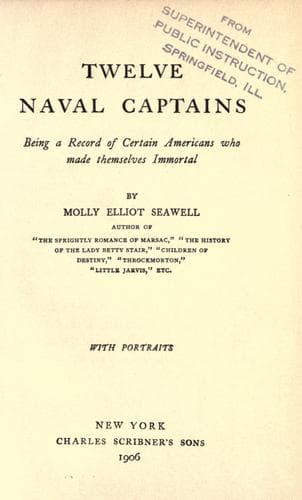
Twelve Naval Captains: Being a Record of Certain Americans Who Made Themselves ImmortalSeawell, Molly Elliot
History
Twelve Naval Captains: Being a Record of Certain Americans Who Made Themselves Immortal
Seawell, Molly Elliot
United States. Navy -- Biography
The beginning of the autumn marked the end of the season for active
operations, and the American squadron withdrew, with a promise to
return the next season and do yet more damage,--a calamity which the
Bashaw avoided by promptly giving up the American prisoners the next
spring, when the Americans, true to their word, returned in greater
force. A relief squadron which had been sent out from the United
States arrived just at the close of the campaign before Tripoli. It
brought out Decatur's commission as a post-captain, as well as lesser
promotions for the other young commanding officers. Commodore Preble,
on being relieved by Commodore Barron, turned over the Constitution
to Decatur, who thus, at twenty-five, commanded what was probably
the finest frigate in the world. His rank, however, as the youngest
post-captain in the navy did not entitle him to keep her very long,
and he was transferred to the Congress, a smart thirty-eight-gun
frigate. She was in the squadron of Commodore Rodgers, which, after
the humbling of Tripoli, was engaged in bringing the Bey of Tunis to
terms. Commodore Rodgers sent Decatur, who was well known to the heads
of Barbary powers, to negotiate a treaty with Tunis. The Bey at first
refused to receive him. Decatur returned to his ship, which was cleared
for action, and sent a message saying that the Bey must decide at once
between war and peace. The Bey succumbed immediately, and not only
begged for peace, but asked that the Congress should convey a Tunisian
envoy to the United States. This was rather more than Decatur had
bargained for, particularly as he had to give up a part of his quarters
to the Tunisian envoy and his suite. But having succeeded rather better
than he expected, Decatur took the party on board and returned to the
United States, reaching home in 1805.
He was received with praise, admiration, and the highest personal and
official favor. He was given good commands, and a few years after
he had gone out to the Mediterranean to command a little twelve-gun
schooner, he again went out in command of a splendid squadron, his
broad pennant flying on the mighty Constitution. He was sent to demand
reparation from the Dey of Algiers for certain injuries to American
citizens. The American consul went in person to see the Dey, who sat
in state, looking through the open window at the formidable force
with which Decatur was prepared to enforce his demands. The consul
began by saying, significantly, that the squadron was commanded by
Commodore Decatur. The Dey, gravely combing his beard with a diamond
comb, said: "I know this Decatur. He is the man who burnt the frigate
at Tripoli. Hum! Why do the Americans send wild young men to treat with
old powers?" Nevertheless, he very promptly gave all the satisfaction
demanded by the "wild young man."
Public-domain text, read in full here on John Shaqi.
Reviews
Reviews
No reviews yet
Be the first to share your thoughts on this work.
Elsewhere in the archive
Join the Discussion
Join the discussion
Sign in to leave a comment or review.
Sign InorCreate an account