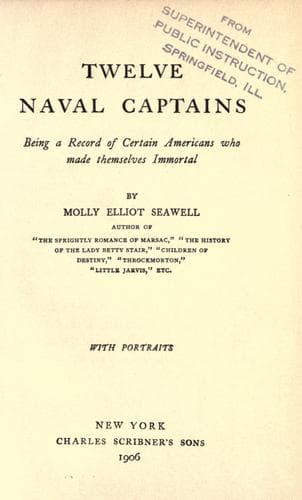
Twelve Naval Captains: Being a Record of Certain Americans Who Made Themselves ImmortalSeawell, Molly Elliot
History
Twelve Naval Captains: Being a Record of Certain Americans Who Made Themselves Immortal
Seawell, Molly Elliot
United States. Navy -- Biography
On the outbreak of hostilities with Great Britain in 1811-12, Decatur
got the command of the United States,--"Old Wagoner," the stanch and
weatherly frigate in which he had made his first cruise with his
beloved Somers. In her he made the second capture of a frigate in that
war, Hull having preceded him in the capture of the Guerrière by the
Constitution.
Off Madeira, on the 25th of October, the United States sighted the
Macedonian,[12] a magnificent thirty-eight-gun frigate, commanded by
Captain Carden. Decatur and Carden were personal friends, and before
the war broke out had often discussed the relative fighting powers of
their ships. Decatur's black servant had listened to these talks as
he stood behind his master's chair. Captain Carden frequently said,
"No, my dear Decatur. Your men are brave, but not experienced; and
when they meet a British ship of equal force, with the best intentions
to do their duty, they will not know how to fight." Cuffee remembered
this, and as soon as it was known on "Old Wagoner" that the approaching
frigate was the Macedonian, he very prudently retired to the lower
hold, and hid behind a hogshead.
The action began with the greatest spirit on both sides, the ships
keeping up a furious cannonade at close quarters, with a heavy sea
on and a good breeze blowing. The Americans showed great superiority
in gunnery, and although the British fought with a gallantry worthy
of British tars, and their officers nobly encouraged them by word
and example, in seventeen minutes from the time the first broadside
struck the Macedonian all was over, and her colors were hauled down.
She had suffered terribly, more than a third of her men being killed
and wounded. She lost so many men at the guns that the marines were
called upon to work the batteries. On the American ship only twelve men
were killed and wounded, and the marines during the whole battle were
drawn up in the waist of the ship, with nothing to do. This, however,
was much more trying than fighting, as they had to stand as if they
were on parade, while shot and shell screamed a few inches above their
heads. The men, however, showed the utmost steadiness, and acted as
well as looked as if they were merely at Sunday morning quarters. When
the Macedonian struck, it was plain from the way she was cut up that
she had made a good and gallant defence. As Captain Carden came over
the side, he offered his sword to Decatur, who refused to take it,
saying,--
"I cannot take the sword of a man who has so bravely defended his ship."
The solemn silence of the occasion was broken by Cuffee, who, the
danger being over, had crawled up out of the hold, and appeared upon
the quarterdeck at that moment, just in time to bawl out,--
"I say, Marse Carden, what you think now 'bout de way dem 'Mericans
fights!"
Public-domain text, read in full here on John Shaqi.
Reviews
Reviews
No reviews yet
Be the first to share your thoughts on this work.
Elsewhere in the archive
Join the Discussion
Join the discussion
Sign in to leave a comment or review.
Sign InorCreate an account