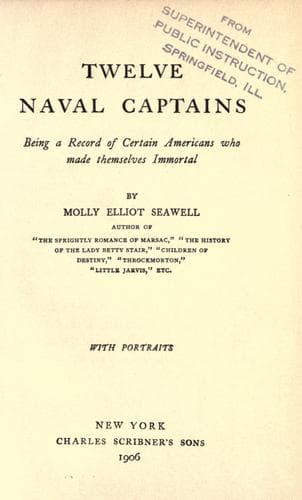
Twelve Naval Captains: Being a Record of Certain Americans Who Made Themselves ImmortalSeawell, Molly Elliot
History
Twelve Naval Captains: Being a Record of Certain Americans Who Made Themselves Immortal
Seawell, Molly Elliot
United States. Navy -- Biography
Paul Jones's rage at this was furious, and it became impossible for
him to serve in the same ship with Commodore Hopkins, who was shortly
afterward censured by Congress, and within the year dismissed from
the navy. In the summer of 1776 Paul Jones was given the command of a
little sloop, the Providence, mounting only twelve four-pounders, but
a fairly smart and weatherly vessel. He improved her sailing qualities
so that she could log it faster than a great many better ships. With
this little sloop he was employed in conveying military stores from
New England to Washington's army on Long Island; and as the coast and
the sounds swarmed with the cruisers of Lord Howe's fleet, this was a
difficult and daring undertaking. But in difficulty and daring Paul
Jones always shone, and he succeeded so as to win the admiration and
personal regard of Washington, as well as the approval of Congress. In
the autumn he made a more extended cruise, during which he captured
several valuable prizes, and showed his courage and seamanship by
manoeuvring boldly before the Solebay frigate and then running away
from her. The Solebay thought she had bagged the Providence, when
the little sloop, suddenly weathering her, ran directly under her
broadside, where the guns could not be brought to bear, and went off
before the wind while the heavy frigate was coming about. On another
occasion he was chased by the Milford frigate. Finding the Providence
was fast enough to play with the Milford, Paul Jones kept just out of
reach of the heavy cannonade of the Milford; and every time the frigate
roared out her heavy guns, a marine, whom Paul Jones had stationed aft
on the Providence, banged away with his musket in reply. This amused
and delighted the men, and when Paul Jones was ready he ran away from
the frigate, leaving her still thundering away in his wake. These
little events had a good effect on his officers and men, showing them
that they had a man of dash and spirit for their captain. When his
cruise was up, he received full recognition of his services by being
appointed to command a splendid frigate then building in Holland for
the American government. Meanwhile he was ordered to take command of
the Ranger, a sloop-of-war, mounting eighteen light guns, then fitting
for sea at Portsmouth, New Hampshire. On the very day he was appointed
to her, June 14, 1777, Congress adopted the stars and stripes as the
national ensign, and Paul Jones always claimed that he was the first
man to hoist the new flag over a ship of war when he raised it on the
Ranger in Portsmouth harbor.
Public-domain text, read in full here on John Shaqi.
Reviews
Reviews
No reviews yet
Be the first to share your thoughts on this work.
Join the Discussion
Join the discussion
Sign in to leave a comment or review.
Sign InorCreate an account