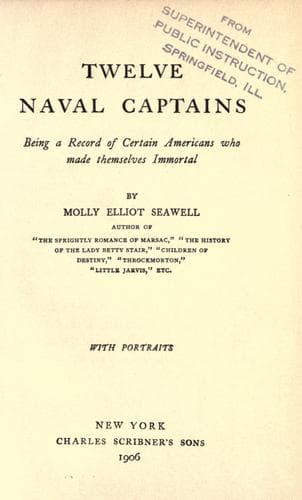
Twelve Naval Captains: Being a Record of Certain Americans Who Made Themselves ImmortalSeawell, Molly Elliot
History
Twelve Naval Captains: Being a Record of Certain Americans Who Made Themselves Immortal
Seawell, Molly Elliot
United States. Navy -- Biography
By that time it was known that war was imminent, and Hull kept his
ship prepared for action at a moment's notice. It seemed at one time
as if the Constitution would fire the first gun of the conflict in an
English port. The Havana, frigate, lay close to the Constitution,
and one night a man from the American frigate jumped overboard and
swam to the Havana, where he was taken aboard. Next morning Hull sent
a boat with Morris, to ask the man's surrender. The British captain
declined to give him up, saying that the man swore he was a British
subject. As the British navy made laws for the navies of the world in
those days, the Americans had to submit with a very bad grace. But
compensation was at hand. A man from the Havana, seeing the turn of
affairs, jumped overboard and swam to the Constitution. He was welcomed
on board, one may be sure, and when the Havana's lieutenant sent
after him, Hull coolly announced that the man said he was an American
citizen, and therefore would not be given up. The British captain
had to be satisfied with this answer. But there was some expectation
that an attempt would be made to seize the man by force. Meanwhile
Hull concluded to change his berth, the Havana and her consort being
a little too near; so he picked up his anchor, and dropped down to
leeward a mile or two. The Havana promptly followed him. Hull then
thought it likely that he would be attacked before morning, and made
his preparations accordingly. The ship was cleared for action, the
cabin torn out of the way, the battle lanterns lighted, and the men
sent to their quarters at the tap of the drum. Hull, full of fire and
determination, said to the men,--
"My lads, are you ready for a fight? I don't know but what this frigate
is after us. Are you ready for her?"
The reply was a rousing American cheer. Even some men who were in irons
joined in the cheering, and contrived to get a message to the captain
asking to be released during the time of the expected fight, that they
might do their duty. This was done, and amid the greatest enthusiasm
the guns were cast loose. It was noted that the men took hold of the
gun tackles as if they meant to jerk the guns through the ship's side.
Lieutenant Morris, passing along the batteries, told the men that if
the ship had to fight, it would be in their quarrel, and he hoped they
would give a good account of themselves. The reply of these gallant
tars was, "Let the quarterdeck look out for the colors, and we will
look out for the guns."
Some hours having passed, with the Constitution plainly ready for
a fight, without any demonstration from the British frigate, Hull
determined to lift his anchor and sail for France. The men responded
with a loud groan to the boatswain's call to man the capstan bars, and,
sailor-like, were acutely disappointed that they got off without a
chance to show what the ship could do.
Public-domain text, read in full here on John Shaqi.
Reviews
Reviews
No reviews yet
Be the first to share your thoughts on this work.
Elsewhere in the archive
Join the Discussion
Join the discussion
Sign in to leave a comment or review.
Sign InorCreate an account