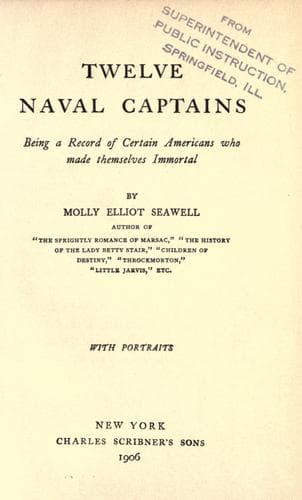
Twelve Naval Captains: Being a Record of Certain Americans Who Made Themselves ImmortalSeawell, Molly Elliot
History
Twelve Naval Captains: Being a Record of Certain Americans Who Made Themselves Immortal
Seawell, Molly Elliot
United States. Navy -- Biography
Hull returned to the United States, and in June, 1812, war was
declared. The Constitution was at Annapolis, where she had been newly
coppered, and where a sloop-of-war was also being fitted out. A report
got about, among the Constitution's crew, that men were to be drafted
from her to the sloop-of-war. This created great dissatisfaction. The
men, nearly all native-born Americans, although new to the ship, were
proud of her, and had a superstitious faith in her good fortune and
were devoted to their captain. Their complaints became almost mutinous,
when Hull appeared among them and assured them that not a man should
be taken out of the ship. This pacified them, and on the 14th of July,
1812, they sailed for New York, to join Commodore Rodgers's squadron.
About four o'clock on the morning of July 19th, the cry rang through
the ship that the American squadron was sighted; but as day broke, it
was found that the Constitution was almost surrounded by a British
squadron under Admiral Broke, one of the finest seamen in the British
navy. It consisted of the Africa, sixty-four; the frigates Shannon and
Guerrière, of thirty-eight guns each (with the last the Constitution
was to have it out, yardarm to yardarm, that day month); the light
frigates Belvidera and Eolus; and two small vessels. By sunrise it fell
almost calm, and it seemed as if the glorious frigate would have to lie
where she was, to be eaten up by her enemies as soon as the wind rose.
But Hull and Morris were men of resource, and while fully prepared to
go down fighting, if necessary, they knew a way of getting off even
without a wind. All the spare hawsers in the ship were bent together,
and to a kedge anchor which was put in a boat, sent ahead half a mile,
and let go. The crew, at a signal, clapped on, and walked away with the
ship. Before she lost the impetus gained by rousing on the one kedge,
another one was carried ahead and let go; and so she progressed at the
rate of about three knots an hour. At first the British were amazed to
see her trotting off without a wind; but they soon found out what was
going on, and put all the available boats in the squadron to towing the
Shannon after the Constitution. The Shannon, however, could not make
much headway, as Hull had mounted stern-chasers in the cabin, and fired
on the British boats whenever they came within range.
Public-domain text, read in full here on John Shaqi.
Reviews
Reviews
No reviews yet
Be the first to share your thoughts on this work.
Elsewhere in the archive
Join the Discussion
Join the discussion
Sign in to leave a comment or review.
Sign InorCreate an account