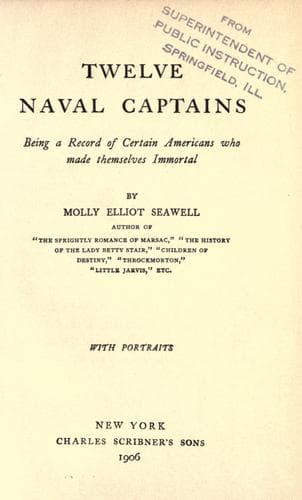
Twelve Naval Captains: Being a Record of Certain Americans Who Made Themselves ImmortalSeawell, Molly Elliot
History
Twelve Naval Captains: Being a Record of Certain Americans Who Made Themselves Immortal
Seawell, Molly Elliot
United States. Navy -- Biography
After working all night the morning of the 20th of August saw the brave
but unfortunate Guerrière made ready for her ocean grave. A slow match
was applied to her magazine, and the Constitution bore away. About
three miles off she hove to, while her officers and men, together with
those of the doomed frigate, waited breathlessly for the explosion.
As the fire gained headway, a dense volume of smoke formed over her.
Some of her guns had been left shotted, and as the fire reached them,
they began to go off, their sullen boom over the sea sounding like
the death-knell of the gallant ship. Presently the flames reached the
magazine. Streams of light, and a roar that seemed to shake the deep,
followed; a mass of wreckage flew skyward; the Guerrière was no more.
There was great uneasiness felt on board the Constitution in regard
to the large number of prisoners she carried. There were not enough
handcuffs in the ship for the whole British crew, and the Americans
felt a manly unwillingness to handcuff any of the men who had fought
them so bravely. But it was noted that from the start the prisoners and
their captors behaved well, the American and British sailors sitting
around the fok'sle together, spinning yarns, exchanging tobacco, and
chumming quite amicably.
Hull made for Boston, and on his arrival there was greeted with the
wildest enthusiasm. The people were beside themselves with joy. Before
this a British ship had been deemed invincible, and the knowledge that
one of these great ships, with a captain and crew worthy of her, had
struck to an American captain who had never before handled a frigate
in action, was gratifying to the national pride. Hull, to his great
discomfiture, was seized, as he stepped upon the dock, and carried on
the shoulders of his admirers to his destination. A grand banquet was
given to him and his officers in Faneuil Hall. Congress had a medal
struck in his honor, and gave swords to the officers and a handsome sum
in prize money to the crew. So great was Hull's popularity that the
commissioners of the navy would not have taken the ship away from him,
had he asked to retain her, but with true magnanimity he gave her up
to Bainbridge. Hull knew that Bainbridge was justly entitled to her,
and he was not the man to withhold anything from a brother in arms.
Bainbridge therefore took her, and went out and captured the Java.[17]
Hull was actively, though not brilliantly, employed during the rest
of the war, but did not get afloat again, as there were more captains
than frigates. In 1813 he married a beautiful girl, the daughter of
a clergyman. She had laughed at his pretensions when he was only a
lieutenant; but after his great cruise she said, when she knew it would
be repeated to Hull, "How delightful it must be to be the wife of a
hero!" He took the hint, and soon after they were married.
Public-domain text, read in full here on John Shaqi.
Reviews
Reviews
No reviews yet
Be the first to share your thoughts on this work.
Elsewhere in the archive
Join the Discussion
Join the discussion
Sign in to leave a comment or review.
Sign InorCreate an account