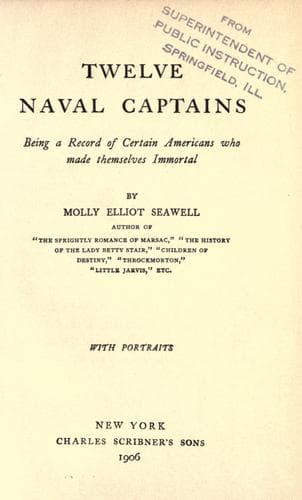
Twelve Naval Captains: Being a Record of Certain Americans Who Made Themselves Immortal — John Shaqi
Twelve Naval Captains: Being a Record of Certain Americans Who Made Themselves ImmortalSeawell, Molly Elliot
History
Twelve Naval Captains: Being a Record of Certain Americans Who Made Themselves Immortal
Seawell, Molly Elliot
United States. Navy -- Biography
His determined attitude had its effect. The French admiral agreed
to salute the Ranger, and to make sure that it was done in broad
daylight, so there could be no misunderstanding about it, Paul Jones
kept his ship in the lower bay until the next day. The French admiral
paid the American commander the compliment of having the guns manned
when the Ranger sailed through the double line of the French fleet,
and when the French guns roared out in honor of the American flag,
it meant that France was from that day openly, as she had been for
some time secretly, committed to an alliance with the struggling
colonies. Seeing that nothing was to be hoped for in the way of a
better ship, Paul Jones, like all truly great men, determined to do
the best he could with the means at hand. So, on an April evening in
1777, he picked up his anchor and steered the little Ranger straight
for the narrow seas of Great Britain, the Mistress of the Seas, and
the greatest naval power on earth. The boldness of this can scarcely
be overestimated. The French admirals, with fifty-five ships of the
line, hung on to their anchors, not caring to risk an encounter with
the fleets of England, manned by her mighty captains and heroic crews;
but Paul Jones, alone, in a weak vessel, lightly armed, took all the
chances of destruction, and bearded the lion in his den. He counted on
the slowness of communication in those days, and all of those other
circumstances in which fortune favors the brave,--and the result
justified him.
He cruised about for several days, burning and destroying many merchant
ships. He landed at St. Mary's Isle, in order to capture the Earl of
Selkirk, but the bird had flown. His men became mutinous, because,
contrary to the custom of the time, they were not allowed to loot the
place. Paul Jones was forced to allow them to carry off some silver
plate, which he afterward redeemed out of his own pocket, and returned
to Lady Selkirk. He also landed at Whitehaven, and fired the shipping
in the port, although he did not succeed in burning the vessels. But
the desire of his heart was to find a ship of war, not too strong for
him, with which he might fight it out, yardarm to yardarm. This he
found in the Drake, a sloop-of-war, carrying twenty guns, and lying
off Carrickfergus. Like the Ranger, she was a weak ship; but she
carried brave men and a fighting captain, and when, on the afternoon
of the 24th of April, the Ranger appeared off Carrickfergus, the
Drake promptly came out to meet her. The tide was adverse, and the
Drake worked out slowly, but her adversary gallantly waited for her in
mid-channel, with the American ensign at her mizzen peak, and a jack at
the fore. The Drake's hail, "What ship is that?" was answered by the
master, under Paul Jones's direction: "This is the American Continental
ship Ranger. We wait for you and beg you will come on. The sun is but
little more than an hour high, and it is time to begin."
Public-domain text, read in full here on John Shaqi.
Reviews
Reviews
No reviews yet
Be the first to share your thoughts on this work.
Join the Discussion
Join the discussion
Sign in to leave a comment or review.
Sign InorCreate an account