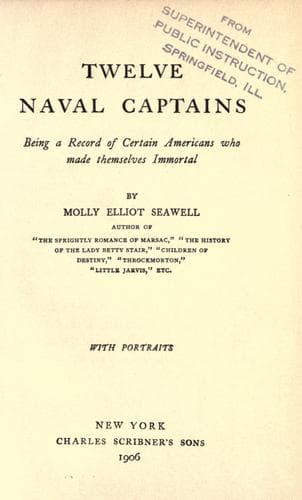
Twelve Naval Captains: Being a Record of Certain Americans Who Made Themselves ImmortalSeawell, Molly Elliot
History
Twelve Naval Captains: Being a Record of Certain Americans Who Made Themselves Immortal
Seawell, Molly Elliot
United States. Navy -- Biography
"Two," answered the pilot; when, seeing Stewart's countenance turn pale
with apprehension, he added nonchalantly: "And afore long she won't
have but one!"
The effect of this news upon the captain of a war-ship may be imagined;
but in a moment or two the ship slipped into deep water, and, carrying
sail hard, got into Marblehead safe and sound, while cheering
multitudes flocked to the shore to welcome her.
In a few days Stewart succeeded in slipping into Boston again,--the
sixth time in the course of the war that the ship had eluded the
British blockade. Stewart took up his berth in the upper harbor, and as
he was known to be a fighting captain with a fighting ship, the State
and city authorities concluded that they would rather have him a little
farther off. Accordingly they asked him to take his ship down into the
lower harbor, as, if the British blockading fleet attacked him where
he was, the cannonade would do great damage to the town. Stewart's
reply to this request was characteristic. He coolly informed them that
he should stay where he was, but it would make very little difference
to them where he lay, as, "if attacked, I shall make such a defence as
will endanger the town." He recommended them to build some additional
batteries to defend the town. The authorities had to be satisfied
with this reply; but they took Stewart's advice, and increased their
batteries so that they were better prepared than before to meet a
bombardment, should the British fleet treat them to one.
On the 17th of December, 1814, Stewart again slipped past the
blockading fleet, making the seventh time the Constitution had done
this, and sailed on his last and greatest cruise. He had lately been
married, and it is said that he asked his wife what he should bring
home to her. She replied, "A British frigate." Stewart replied, "I will
bring you two of them." He kept his promise.
Stewart was soon on the broad ocean. Nothing of note happened until
February, when one morning, off the coast of Portugal, Stewart suddenly
and from no reason he was able to give, except an unaccountable impulse
to proceed to a certain spot in the Atlantic, changed the ship's
course and ran off sixty miles to the southwest. At two o'clock in the
afternoon of the 20th of February, 1815, about sixty leagues southwest
of the Madeira islands, a small frigate, the Cyane, was sighted, and
a little later a large sloop-of-war, the Levant. The Constitution
immediately gave chase, although it was thought that one of the ships
was much heavier than she really was, as she had double gun-streaks and
false ports painted amidships, which the Americans, in chasing, took
for real guns and ports.
Public-domain text, read in full here on John Shaqi.
Reviews
Reviews
No reviews yet
Be the first to share your thoughts on this work.
Elsewhere in the archive
Join the Discussion
Join the discussion
Sign in to leave a comment or review.
Sign InorCreate an account