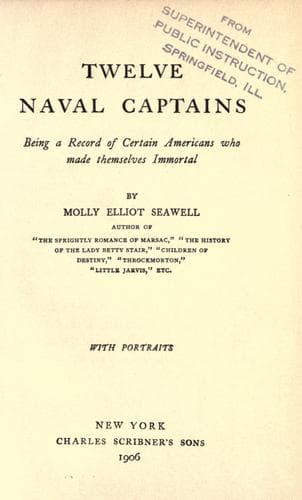
Twelve Naval Captains: Being a Record of Certain Americans Who Made Themselves ImmortalSeawell, Molly Elliot
History
Twelve Naval Captains: Being a Record of Certain Americans Who Made Themselves Immortal
Seawell, Molly Elliot
United States. Navy -- Biography
They did not know Stewart, though. As soon as the darkness of the
winter night came, and the tide began to lift the ship out of the mud,
he sent pilots ahead to buoy the channel with lights. The ship, helped
somewhat by the wind, but towed by the boats, would go a mile or two up
to the nearest buoy, when that light would be put out, and she would
be headed for the next one. So quietly was this done that the British
never suspected what was going on. But when daylight came there was no
Constellation to be seen; she was safe in the Elizabeth River.
The British determined to blockade her there, and succeeded in doing
so; but although they made several desperate attempts to carry her
by boarding, they never succeeded. Stewart had her so well guarded
with boats, and the boats with a circle of booms, while the ship was
protected with boarding netting, her guns kept double-shotted, and her
officers and crew always on the alert, that her enemies themselves
were forced to admire the care taken of her. It was the joke among the
British officers that Stewart must be a Scotchman, he was so wary and
so watchful with his ship; and the British Admiral is said to have
remarked: "If that had been a French ship, we would have had her long
ago."
Having satisfied himself that although the Constellation could not
be taken, yet it was unlikely that she would get out during the war,
Stewart applied for and got the Constitution. This was in 1814. The
Constitution had then made her celebrated escape from Admiral Broke's
squadron, and had destroyed the Guerrière and the Java,--for when "Old
Ironsides" got through with an enemy, he was generally past saving.
It may be imagined with what splendid hopes Stewart took the great
ship after she had been refitted at Boston. He got out, although seven
British ships blockaded Boston, and sailed to the West Indies. He
made a few prizes, and took a small British cruiser; but this was not
enough for the Constitution to do. Stewart's disappointment with his
cruise was great, and it almost seemed as if the ship were no longer
to be a favorite of fortune, until she was chased by two frigates,
the Junon and the Tenedos, off the Massachusetts coast. Stewart had
a good pilot aboard, and he made for Marblehead under a spanking
breeze, with the two British frigates legging it briskly after him. The
Constitution drew about twenty-two feet of water, and Stewart could
not conceal his anxiety as the pilot carried her along the dangerous
coast, and it seemed as if any moment she might be put on the rocks.
The pilot, though, a cool-headed, steady fellow, knew his business,
and was nettled at Stewart's evident uneasiness. The British ships,
not knowing the coast, declined to follow, and were falling slightly
astern; but it looked as if the Constitution would only escape one
danger to be destroyed by another. Presently Stewart asked the pilot
for the hundredth time,--
"How many feet of water has she under her keel now, pilot?"
Public-domain text, read in full here on John Shaqi.
Reviews
Reviews
No reviews yet
Be the first to share your thoughts on this work.
Elsewhere in the archive
Join the Discussion
Join the discussion
Sign in to leave a comment or review.
Sign InorCreate an account