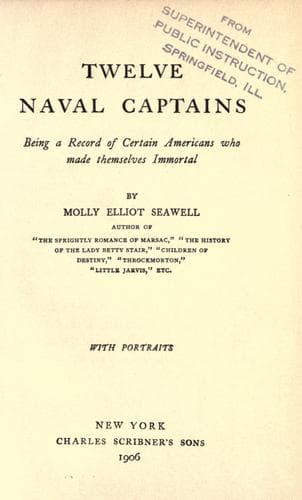
Twelve Naval Captains: Being a Record of Certain Americans Who Made Themselves ImmortalSeawell, Molly Elliot
History
Twelve Naval Captains: Being a Record of Certain Americans Who Made Themselves Immortal
Seawell, Molly Elliot
United States. Navy -- Biography
"Oh, Captain Falcon," he cried, "look at the large ship in the offing!"
"Hold your tongue, you little rascal!" answered Captain Falcon, in a
low voice.
The American lieutenant looked up and saw, on the top of a fog bank
that lay on the water, the sails of a large ship. Indistinctly as
she was seen, the squareness and smartness of her rig induced the
lieutenant to think her a man-of-war. Instantly he went below and
told the captain. Stewart, who was shaving, without stopping in his
occupation, directed him to call the men to quarters, and make ready
to go out and attack the advancing ship. The lieutenant went on deck,
gave the order, and it was promptly obeyed. The men were not surprised,
because, as they explained, a dog belonging to the ship had been
drowned that day, and they knew they would have to fight or run within
twenty-four hours. Then the lieutenant noticed that two more ships had
appeared above the fog-bank, with the first one. He ran below to tell
this to Stewart, who was wiping his face and getting into his uniform
at the same time.
"Cut the cables," he said, "and signal the prizes to do the same and
follow us out."
In another minute he was on deck, and the cables were cut, leaving the
anchors at the bottom, and sail was being made with perfect order and
marvellous rapidity. In fourteen minutes from the time the first ship
had been seen, and ten minutes from the time the Constitution's cable
had been cut, the frigate was standing out of the roads under a cloud
of canvas, ready to fight or run, as occasion might require.
The trade winds were blowing, and the Constitution, with her two
prizes, passed within gunshot of the three strangers. Some of the
English prisoners who had been landed, manned a battery on shore and
opened fire on the Americans. This and other circumstances revealed
to the British squadron that the three ships making out to sea were
American men-of-war, and they promptly tacked and followed.
The British ships were the Acasta, of forty guns, a very fast ship; the
Leander, of fifty guns; and the Newcastle, of fifty guns, all belonging
to Admiral Sir George Collier's fleet. The British officers, prisoners
on the Constitution, became jubilant as the British ships gained on the
Constitution with her two prizes, and promised the Americans that "Kerr
in the Acasta" would soon overhaul the Americans. One of the British
captains, standing in the stern gallery, called out as the Acasta
neared the Constitution, "Captain Kerr, I envy you your glory this day!"
Public-domain text, read in full here on John Shaqi.
Reviews
Reviews
No reviews yet
Be the first to share your thoughts on this work.
Elsewhere in the archive
Join the Discussion
Join the discussion
Sign in to leave a comment or review.
Sign InorCreate an account