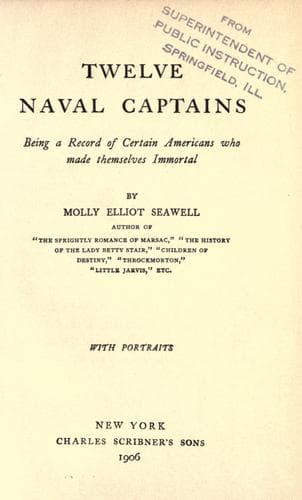
Twelve Naval Captains: Being a Record of Certain Americans Who Made Themselves ImmortalSeawell, Molly Elliot
History
Twelve Naval Captains: Being a Record of Certain Americans Who Made Themselves Immortal
Seawell, Molly Elliot
United States. Navy -- Biography
Stewart, with his men at quarters and every rag of canvas set that
would draw, was edging off, but prepared to fight the three heavy
frigates with the Constitution and the two smaller ships if obliged
to. He signalled the Cyane and the Levant to take different courses,
so that the British squadron might divide in pursuit. This was done,
and to the amazement of the Americans and the painful chagrin of the
British prisoners the Acasta suddenly went about in pursuit of the
Levant, which, by a singular mistake, was supposed to be a heavy
American frigate; the other two ships followed, while the Constitution
was trotting off at an eleven-knot gait.
The Levant put back to Porto Praya, which was a neutral port; but
the three frigates, after chasing her in, opened fire on her, and
her commander, Lieutenant Ballard, of the Constitution, hauled down
his flag. He had his revenge, though. When the British prize-master
came on board to take possession of the Levant, he said, "This is, I
presume, the American man-of-war Peacock." "You are mistaken, sir,"
replied Ballard coolly; "this is the Levant, late of his Britannic
Majesty's navy, and prize to the United States ship Constitution."
The commander of the British squadron was censured at home for his
mistake in leaving the Constitution that he might go in pursuit of the
smaller ship; and the affair on the part of the British was thought to
have been bungled to the last degree.
Stewart carried the grand old ship into New York the middle of May, and
then learned that peace had been made many months before.
He was received with acclamations. The people by that time had come
to believe the ship invincible. Besides her glorious career before
Tripoli, she had made two extraordinary escapes from British squadrons.
She had run the blockade seven times through large British fleets.
She had captured two heavy frigates, one light frigate, a large
sloop-of-war, and many merchant-ships, and had made more than eleven
hundred prisoners. Her fire had always been fearfully destructive,
while she had never had any great slaughter on her decks, nine being
the largest number killed in any single engagement. She had never lost
her commanding officer, either by wounds or death, had never lost a
mast, and had never taken the ground. This record is not one of chance.
She was, first, one of the best built frigates in the world; and,
second, she was officered and manned in a surprisingly good manner. Her
crews were generally made up wholly of American seamen and her four
great commanders during her warlike career--Preble, Hull, Bainbridge,
and Stewart--would have given a good account of any ships they might
have commanded.
Congress rewarded Stewart by a gold medal and a resolution of
thanks. His officers received silver medals, and there was the usual
distribution of prize-money among the officers and crew.
Public-domain text, read in full here on John Shaqi.
Reviews
Reviews
No reviews yet
Be the first to share your thoughts on this work.
Elsewhere in the archive
Join the Discussion
Join the discussion
Sign in to leave a comment or review.
Sign InorCreate an account