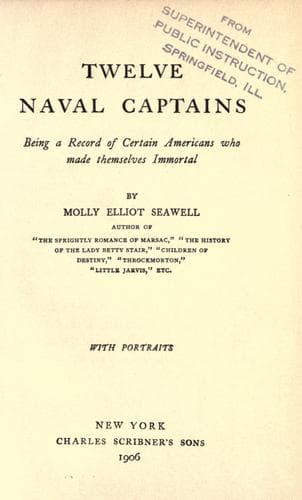
Twelve Naval Captains: Being a Record of Certain Americans Who Made Themselves ImmortalSeawell, Molly Elliot
History
Twelve Naval Captains: Being a Record of Certain Americans Who Made Themselves Immortal
Seawell, Molly Elliot
United States. Navy -- Biography
Stewart had a long and distinguished career in the navy, rising in
1859 to be senior officer; but his fighting days were his early days.
He commanded the Franklin in 1817, a splendid line-of-battle ship,
and took her to Europe under his broad pennant as Commodore. She was
visited by the Emperor of Austria, and many royal persons, besides
officers of high rank in foreign navies, all of whom were struck with
admiration at her beauty, force, and the fine crew she carried. Stewart
was retired in 1861, and spent his last days at his country-place, "Old
Ironsides," in New Jersey. Among the souvenirs of his great fight was
a rude iron hilt to his full-dress sword, a superb Toledo blade. The
gold hilt had been shot away in his great fight, and the ship's armorer
had made an iron one, which Stewart afterward wore.
He died in 1869, after having been borne on the navy list for
seventy-one years, and he was the last survivor of the great captains
of 1812-15.
OLIVER HAZARD PERRY.
The victory won by Perry on Lake Erie, September 10, 1813, has ever
been one of great popular renown. It was won in the sight and knowledge
of the American people; it was the first success the American navy ever
won in squadron; the consequences were important; and the fact that the
battle was won on the Canadian line, where the American army had met
with reverses, was gratifying to the national vanity.
[Illustration: Oliver H. Perry]
Perry's youth--he was barely eight-and-twenty--was a captivating
element in his success, and as the victory was due in a great measure
to his personal intrepidity, he was justly admired for it. He cannot
be classed with those American commanders, like Paul Jones, Preble,
Decatur, and Hull, who, either in meeting danger or escaping from
it, seemed able to compass the impossible; but he was a man of good
talents, of admirable coolness and courage, and prone to seek active
duty and to do it.
Perry was born in Rhode Island in 1785. His father was a captain in
the infant navy of the country, as it was reorganized at the time of
the French aggressions. Captain Perry's first duty was to supervise
the building of a vessel of war at Warren, Rhode Island, some distance
from his home. He found it necessary to remove to Warren, and took
with him Mrs. Perry, leaving the home-place in charge of Oliver, then
a boy of thirteen. He was, even then, a boy of so much steadiness and
integrity that he was found quite equal to this task. The fever for the
sea, though, seems to have seized him about that time, and in 1799, his
father having command of a small frigate, the General Greene, Oliver
was given a midshipman's commission, and joined his father's ship.
Captain Perry was an officer of spirit and enterprise, and Oliver saw
some real, if not warlike, service in the General Greene.
Public-domain text, read in full here on John Shaqi.
Reviews
Reviews
No reviews yet
Be the first to share your thoughts on this work.
Elsewhere in the archive
Join the Discussion
Join the discussion
Sign in to leave a comment or review.
Sign InorCreate an account