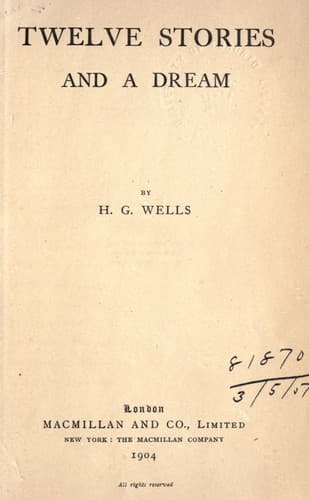
Twelve Stories and a DreamWells, H. G. (Herbert George)
Science
Twelve Stories and a Dream
Wells, H. G. (Herbert George)
Science fiction, English; Short stories
They saw as much of Mr. Ruskin's Florence as the brief time permitted;
he met them in the Pitti Gallery and went round with them, chatting
brightly, and evidently very grateful for their recognition. He knew a
great deal about art, and all four enjoyed the morning immensely. It was
fine to go round recognising old favourites and finding new beauties,
especially while so many people fumbled helplessly with Baedeker. Nor
was he a bit of a prig, Miss Winchelsea said, and indeed she detested
prigs. He had a distinct undertone of humour, and was funny, for
example, without being vulgar, at the expense of the quaint work of
Beato Angelico. He had a grave seriousness beneath it all, and was quick
to seize the moral lessons of the pictures. Fanny went softly among
these masterpieces; she admitted “she knew so little about them,” and
she confessed that to her they were “all beautiful.” Fanny's “beautiful”
inclined to be a little monotonous, Miss Winchelsea thought. She had
been quite glad when the last sunny Alp had vanished, because of the
staccato of Fanny's admiration. Helen said little, but Miss Winchelsea
had found her a little wanting on the aesthetic side in the old days and
was not surprised; sometimes she laughed at the young man's hesitating
delicate little jests and sometimes she didn't, and sometimes she seemed
quite lost to the art about them in the contemplation of the dresses of
the other visitors.
At Rome the young man was with them intermittently. A rather “touristy”
friend of his took him away at times. He complained comically to Miss
Winchelsea. “I have only two short weeks in Rome,” he said, “and my
friend Leonard wants to spend a whole day at Tivoli, looking at a
waterfall.”
“What is your friend Leonard?” asked Miss Winchelsea abruptly.
“He's the most enthusiastic pedestrian I ever met,” the young man
replied, amusingly, but a little unsatisfactorily, Miss Winchelsea
thought. They had some glorious times, and Fanny could not think what
they would have done without him. Miss Winchelsea's interest and
Fanny's enormous capacity for admiration were insatiable. They never
flagged--through pictures and sculpture galleries, immense crowded
churches, ruins and museums, Judas trees and prickly pears, wine carts
and palaces, they admired their way unflinchingly. They never saw a
stone pine or a eucalyptus but they named and admired it; they never
glimpsed Soracte but they exclaimed. Their common ways were made
wonderful by imaginative play. “Here Caesar may have walked,” they would
say. “Raphael may have seen Soracte from this very point.” They happened
on the tomb of Bibulus. “Old Bibulus,” said the young man. “The oldest
monument of Republican Rome!” said Miss Winchelsea.
“I'm dreadfully stupid,” said Fanny, “but who WAS Bibulus?”
There was a curious little pause.
“Wasn't he the person who built the wall?” said Helen.
Public-domain text, read in full here on John Shaqi.
Reviews
Reviews
No reviews yet
Be the first to share your thoughts on this work.
Elsewhere in the archive
Join the Discussion
Join the discussion
Sign in to leave a comment or review.
Sign InorCreate an account