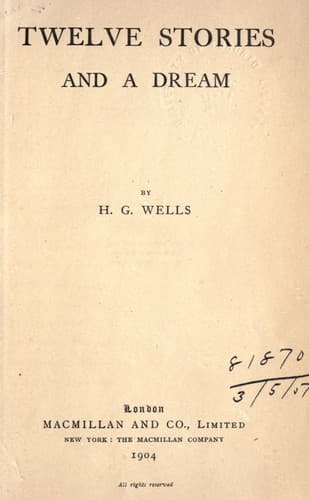
Twelve Stories and a DreamWells, H. G. (Herbert George)
Science
Twelve Stories and a Dream
Wells, H. G. (Herbert George)
Science fiction, English; Short stories
The young man glanced quickly at her and laughed. “That was Balbus,” he
said. Helen reddened, but neither he nor Miss Winchelsea threw any light
upon Fanny's ignorance about Bibulus.
Helen was more taciturn than the other three, but then she was always
taciturn, and usually she took care of the tram tickets and things like
that, or kept her eye on them if the young man took them, and told him
where they were when he wanted them. Glorious times they had, these
young people, in that pale brown cleanly city of memories that was once
the world. Their only sorrow was the shortness of the time. They said
indeed that the electric trams and the '70 buildings, and that criminal
advertisement that glares upon the Forum, outraged their aesthetic
feelings unspeakably; but that was only part of the fun. And indeed Rome
is such a wonderful place that it made Miss Winchelsea forget some
of her most carefully prepared enthusiasms at times, and Helen, taken
unawares, would suddenly admit the beauty of unexpected things. Yet
Fanny and Helen would have liked a shop window or so in the English
quarter if Miss Winchelsea's uncompromising hostility to all other
English visitors had not rendered that district impossible.
The intellectual and aesthetic fellowship of Miss Winchelsea and the
scholarly young man passed insensibly towards a deeper feeling.
The exuberant Fanny did her best to keep pace with their recondite
admiration by playing her “beautiful,” with vigour, and saying “Oh!
LET'S go,” with enormous appetite whenever a new place of interest was
mentioned. But Helen developed a certain want of sympathy towards the
end, that disappointed Miss Winchelsea a little. She refused to “see
anything” in the face of Beatrice Cenci--Shelley's Beatrice Cenci!--in
the Barberini gallery; and one day, when they were deploring the
electric trams, she said rather snappishly that “people must get about
somehow, and it's better than torturing horses up these horrid little
hills.” She spoke of the Seven Hills of Rome as “horrid little hills!”
And the day they went on the Palatine--though Miss Winchelsea did not
know of this--she remarked suddenly to Fanny, “Don't hurry like that,
my dear; THEY don't want us to overtake them. And we don't say the right
things for them when we DO get near.”
“I wasn't trying to overtake them,” said Fanny, slackening her excessive
pace; “I wasn't indeed.” And for a minute she was short of breath.
Public-domain text, read in full here on John Shaqi.
Reviews
Reviews
No reviews yet
Be the first to share your thoughts on this work.
Elsewhere in the archive
Join the Discussion
Join the discussion
Sign in to leave a comment or review.
Sign InorCreate an account