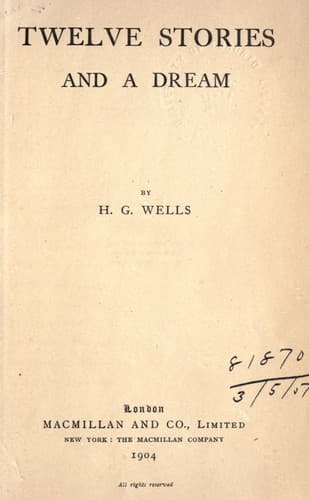
Twelve Stories and a DreamWells, H. G. (Herbert George)
Science
Twelve Stories and a Dream
Wells, H. G. (Herbert George)
Science fiction, English; Short stories
The apartment in which Filmer came to his last solution was a pleasant
little room very simply furnished with green furniture and an old
bureau--for Banghurst was simple in all his private ways. It was hung
with little engravings after Morland and it had a shelf of books. But as
it happened, Banghurst had left a rook rifle he sometimes played with on
the top of the desk, and on the corner of the mantelshelf was a tin with
three or four cartridges remaining in it. As Filmer went up and down
that room wrestling with his intolerable dilemma he went first towards
the neat little rifle athwart the blotting-pad and then towards the neat
little red label
“.22 LONG.”
The thing must have jumped into his mind in a moment.
Nobody seems to have connected the report with him, though the gun,
being fired in a confined space, must have sounded loud, and there
were several people in the billiard-room, separated from him only by a
lath-and-plaster partition. But directly Banghurst's butler opened the
door and smelt the sour smell of the smoke, he knew, he says, what had
happened. For the servants at least of Banghurst's household had guessed
something of what was going on in Filmer's mind.
All through that trying afternoon Banghurst behaved as he held a man
should behave in the presence of hopeless disaster, and his guests
for the most part succeeded in not insisting upon the fact--though to
conceal their perception of it altogether was impossible--that Banghurst
had been pretty elaborately and completely swindled by the deceased. The
public in the enclosure, Hicks told me, dispersed “like a party that has
been ducking a welsher,” and there wasn't a soul in the train to London,
it seems, who hadn't known all along that flying was a quite impossible
thing for man. “But he might have tried it,” said many, “after carrying
the thing so far.”
In the evening, when he was comparatively alone, Banghurst broke down
and went on like a man of clay. I have been told he wept, which must
have made an imposing scene, and he certainly said Filmer had ruined
his life, and offered and sold the whole apparatus to MacAndrew for
half-a-crown. “I've been thinking--” said MacAndrew at the conclusion of
the bargain, and stopped.
The next morning the name of Filmer was, for the first time, less
conspicuous in the New Paper than in any other daily paper in the world.
The rest of the world's instructors, with varying emphasis, according to
their dignity and the degree of competition between themselves and the
New Paper, proclaimed the “Entire Failure of the New Flying Machine,”
and “Suicide of the Impostor.” But in the district of North Surrey the
reception of the news was tempered by a perception of unusual aerial
phenomena.
Overnight Wilkinson and MacAndrew had fallen into violent argument on
the exact motives of their principal's rash act.
Public-domain text, read in full here on John Shaqi.
Reviews
Reviews
No reviews yet
Be the first to share your thoughts on this work.
Join the Discussion
Join the discussion
Sign in to leave a comment or review.
Sign InorCreate an account