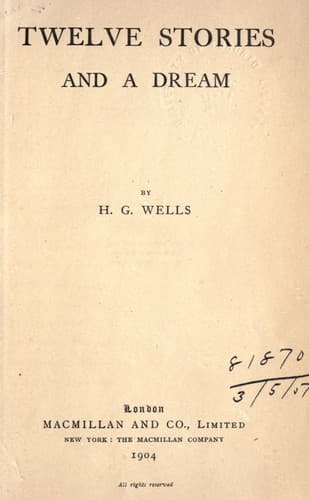
Twelve Stories and a DreamWells, H. G. (Herbert George)
Science
Twelve Stories and a Dream
Wells, H. G. (Herbert George)
Science fiction, English; Short stories
to all previous aeroplanes, and the only engine required was the compact
and powerful little appliance needed to contract the balloons. He
perceived that such an apparatus as he had devised might rise with frame
exhausted and balloons expanded to a considerable height, might
then contract its balloons and let the air into its frame, and by an
adjustment of its weights slide down the air in any desired direction.
As it fell it would accumulate velocity and at the same time lose
weight, and the momentum accumulated by its down-rush could be utilised
by means of a shifting of its weights to drive it up in the air again
as the balloons expanded. This conception, which is still the structural
conception of all successful flying machines, needed, however, a vast
amount of toil upon its details before it could actually be
realised, and such toil Filmer--as he was accustomed to tell the
numerous interviewers who crowded upon him in the heyday of his
fame--“ungrudgingly and unsparingly gave.” His particular difficulty was
the elastic lining of the contractile balloon. He found he needed a new
substance, and in the discovery and manufacture of that new substance he
had, as he never failed to impress upon the interviewers, “performed
a far more arduous work than even in the actual achievement of my
seemingly greater discovery.”
But it must not be imagined that these interviews followed hard upon
Filmer's proclamation of his invention. An interval of nearly five years
elapsed during which he timidly remained at his rubber factory--he
seems to have been entirely dependent on his small income from this
source--making misdirected attempts to assure a quite indifferent
public that he really HAD invented what he had invented. He occupied
the greater part of his leisure in the composition of letters to the
scientific and daily press, and so forth, stating precisely the net
result of his contrivances, and demanding financial aid. That alone
would have sufficed for the suppression of his letters. He spent such
holidays as he could arrange in unsatisfactory interviews with the
door-keepers of leading London papers--he was singularly not adapted for
inspiring hall-porters with confidence--and he positively attempted
to induce the War Office to take up his work with him. There remains a
confidential letter from Major-General Volleyfire to the Earl of Frogs.
“The man's a crank and a bounder to boot,” says the Major-General in
his bluff, sensible, army way, and so left it open for the Japanese
to secure, as they subsequently did, the priority in this side of
warfare--a priority they still to our great discomfort retain.
Public-domain text, read in full here on John Shaqi.
Reviews
Reviews
No reviews yet
Be the first to share your thoughts on this work.
Join the Discussion
Join the discussion
Sign in to leave a comment or review.
Sign InorCreate an account