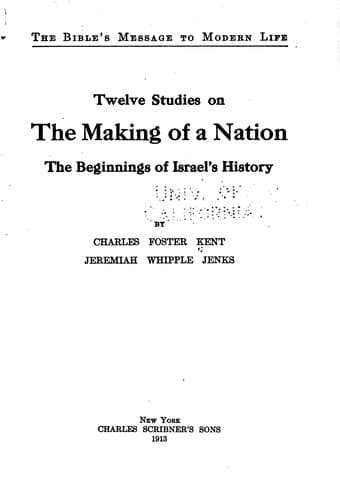
Twelve Studies on the Making of a Nation: The Beginnings of Israel's HistoryKent, Charles Foster
Religion
Twelve Studies on the Making of a Nation: The Beginnings of Israel's History
Kent, Charles Foster
Jews -- History
Kipling's _Law of the Jungle_, in which he lays down the principles
by which the wolf pack secured united action in its hunting, names
the rules that apply almost universally to peoples in the savage
stage of society. According to the researches of the best
anthropologists, savages live in very loosely organized groups,
with no permanent ruler, no regular family law. Each separate
group has its totem, its general rules with reference to the
marriage relation, to hunting and fishing, to shelter and
protection. Practically there are no regular laws. The rules
fixed by custom deal primarily with the marriage relation and with
the securing of food and shelter. They are largely negative. If a
member of the group has met with a misfortune in a certain by-path
or from eating certain food or in other ways, by the action of the
leader of his group that path or that food becomes taboo, and from
that time on it is forbidden. The rules seem generally to be
largely the product of instinct or of experience, without any law
making, and they are enforced almost as instinctively by the common
consent of the people.
II.
THE GROWTH OF CUSTOMARY LAW.
As this loosely associated group condenses into the tribe, all the
members of which regard themselves as descended from a common
ancestor, the organization becomes much more definite under a
patriarchal ruler. Soon through his activities these almost
instinctive habits, guided by rules, assume the nature of customs
that have a sanction, often of religion, practically always of
enforcement through the patriarch. No better illustration of the
crystallization of customs into laws can be found than that given
in Exodus 18:1-27 (_Hist. Bible_, I, 198-202). Moses sat all day
long as judge to decide cases for the people until his
practical-minded father-in-law, Jethro, seeing the waste of time
and energy of the ruler upon whom the welfare of the tribe
depended, proposed a wise plan. He advised that, instead of
rendering decisions regarding each individual case, Moses should
formulate the principles and leave their application to minor
judges appointed by himself as rulers over thousands and over
hundreds and fifties and tens. In modern days the law-making body
is distinct from the judicial. Is there any reason why the judge
should not be the maker of the law he interprets?
Public-domain text, read in full here on John Shaqi.
Reviews
Reviews
No reviews yet
Be the first to share your thoughts on this work.
Elsewhere in the archive
Join the Discussion
Join the discussion
Sign in to leave a comment or review.
Sign InorCreate an account