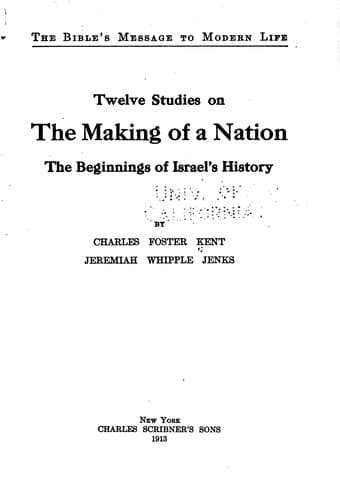
Twelve Studies on the Making of a Nation: The Beginnings of Israel's HistoryKent, Charles Foster
Religion
Twelve Studies on the Making of a Nation: The Beginnings of Israel's History
Kent, Charles Foster
Jews -- History
Doubtless many of the customs thus formulated by Moses had come
down through the preceding ages from the Babylonian and common
Semitic ancestors of the Hebrews. The most striking example of the
pre-Mosaic formulation of custom into law under the sanction of the
deity is found in the so-called code of Hammurabi, which comes from
about 1900 B.C. At the top of the stele which records these laws
this enlightened king depicted himself in a bas-relief as receiving
them from the sun god, Shamash. Hammurabi looked upon himself as a
shepherd chosen by the gods to care for his people. It was his
duty to see "that the great should not oppress the weak, to counsel
the widow and orphan, to render judgment and decide the decisions
of the land, and to succor the injured," in order that "by the
command of Shamash, the judge supreme of heaven and earth, justice
might shine in the land." Many of the principles laid down by him
are also found among the laws attributed to Moses which were
afterward codified in the early decalogues.
At times, though rarely among the Hebrews, we may study custom in
the making, as when in a new situation a ruler renders a decision
which henceforth becomes a law. Thus David, dividing the spoil
after his victory over the Amalekites, established a precedent that
henceforth had binding force upon his followers (I Sam. 30); but in
the majority of such cases the ruler, even when be establishes new
precedents, represents himself as simply interpreting ancient
custom.
As society becomes more and more complex and the interests of
individuals and classes in society clash, besides the judges we
find legislatures making new rules in the form of law. In the
earlier communities practically all law relates to the preservation
of life and of the tribe. Later, as the tribe enters the pastoral
state, private property is established and laws for its care are
made. Still later, with the development of a higher civilization
and with the individual conscience stimulating men to care for the
welfare not merely of their family, but of their nation,
legislation considers primarily the welfare of society. Yet, as
one of our great judges has lately explained, in practically all
stages of society, whenever the population becomes numerous and
business is so developed that we may recognize different classes in
a community, legislation has been primarily in the interests of a
ruling class, often at the expense of the other classes. This
principle is illustrated by certain of the later Jewish ceremonial
laws that brought to the priests a large income at the expense of
the people. Many laws in Europe and in the United States to-day
have been made clearly in the interests of certain classes in
society. Can you think of some?
III.
THE AUTHORITY UNDERLYING ALL LAW.
Public-domain text, read in full here on John Shaqi.
Reviews
Reviews
No reviews yet
Be the first to share your thoughts on this work.
Elsewhere in the archive
Join the Discussion
Join the discussion
Sign in to leave a comment or review.
Sign InorCreate an account