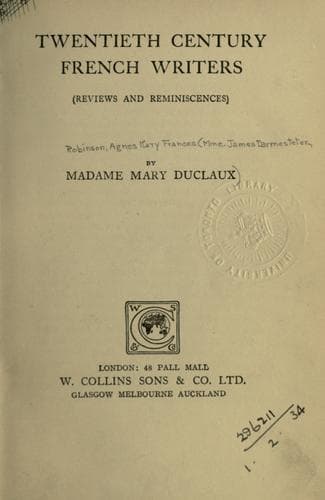
Twentieth Century French Writers: Reviews and ReminiscencesRobinson, A. Mary F. (Agnes Mary Frances)
History
Twentieth Century French Writers: Reviews and Reminiscences
Robinson, A. Mary F. (Agnes Mary Frances)
French literature -- 20th century -- History and criticism
‘Mon amour, je ne puis t’aimer! Le jour éclate
Comme un blanc incendie, au mont des aromates!
Le gazon, telle une eau, fraîchit au fond des bois;
Un délire sacré m’entraîne loin de toi.’
She is relentless, and all the more relentless that she forgets nothing
of their old delights. Since Sappho has any woman uttered such a burst
of passion as she pours out in shameless reminiscence in the marvellous
lyric entitled ‘T’aimer. Et quand le jour timide ...?’ (the day may
enjoy as much timidity as it pleases; the poetess leaves all her share
untouched). Here are the accents of desire, the voice of nature naked
and unashamed; but it is the evocation of a love consumed and finished.
The remembered flame is now a handful of ashes:--
‘Ô cher pâtre, inquiet et désormais terni,
J’ai vécu pour cela, qui est déjà fini!
Is there any happiness to equal our anticipation of happiness? Only in
listening to music can the wearied beauty still believe: ‘Qu’il existe
un bonheur qui ressemble au désir,’ and then the melody of Schumann
seems to ring with a reproach, a warning, a presentiment, a final
certainty:--
‘Je vois, là-bas, dans l’ombre dépouillée
Du jardin où le vent d’automne vient gémir,
Les trahisons, les pleurs, les âmes tenaillées,
Le vieillesse, la mort, la terre entre-bâillée.’
At this point we lose the clue, and wander a while in the Pindaric
labyrinth of lyrics. A new love, fresh, kind, and young, appears
(we think) on the horizon. Mindful of her ancient rigours, our muse
hesitates:--
‘Je porte un vague amour, plus grave et plus ancien,
Qui t’avait précédé et ne peut pas te suivre.’
Yet she does follow her mortal lover. And again she feels that Nature
rejects her, thrusts her, with a flaming sword, forth from her Paradise
into a disordered world of souls and bodies:--
‘Tu n’es plus cette enfant, libre comme la flamme,
Qui montait comme un jet de bourgeons et d’odeurs.’
This new love is of a different sort, turned towards eternity, and
sometimes, as in the song called _Un Abondant Amour_ and also _Je ne
puis pas comprendre, encore que tu sois né_, we feel that it is perhaps
the love for a child. In any case, her passion is for some creature
still innocent and tender. And this new feeling--the point of departure
for the eternal life--does really estrange the poetess from her
frenzied pantheism.
‘Je ne regarde plus
Avec la même ardeur un monde qui m’a plu.
Mon esprit tient captifs des oiseaux éternels....
Je songe au noble éclat des nuits platoniciennes.’
Public-domain text, read in full here on John Shaqi.
Reviews
Reviews
No reviews yet
Be the first to share your thoughts on this work.
Elsewhere in the archive
Join the Discussion
Join the discussion
Sign in to leave a comment or review.
Sign InorCreate an account