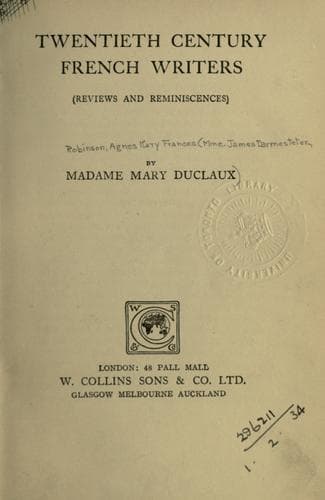
Twentieth Century French Writers: Reviews and ReminiscencesRobinson, A. Mary F. (Agnes Mary Frances)
History
Twentieth Century French Writers: Reviews and Reminiscences
Robinson, A. Mary F. (Agnes Mary Frances)
French literature -- 20th century -- History and criticism
People will read those earlier poems as long as they love gardens
and the frisky joy of flocks, and the swift upsoaring flight of the
eagle above the mountain-tops, and all the innumerable many-twinkling
smile of Nature. For so I should have called her first volume: not
the _Innumerable Heart_ (she had not yet grown a heart) but the
_Innumerable Smile_, ‘ανἠριθμoν γελασμα. That something mad, and
fierce, and glad, and living, can never come again, nor that heroic
impatience of mortality--and morality. Our Muse is no longer twenty.
Like Thekla she has ‘geliebt und gelebet’; she has discovered that
inner universe which has no common measure with the material world; she
has loved and parted; she has loved and lost; she has looked on the
icy face of Death and trembled; she has stood on the pale verge of the
unknown abyss.
As we read these lyrics for their splendid music we gradually perceive
the motives of the symphony. There is more here than beauty. There is
a secret story intricately involved, as in Shakespeare’s sonnets or
Elizabeth Browning’s. The first poems confess the end of a passion,
still deep, and quick, but full of quarrels and combats; we feel the
inevitable rupture close at hand, and the disenchantment which notes
the death of a sentiment that our muse had believed immortal:--
‘Te souviens-tu du temps où, les regards tendus
Vers l’espace, ma main entre tes mains gisante,
J’exigeai de régner sur la mer de Lépante,
Dans quelque baie heureuse, aux parfums suspendus,
Où l’orgueil et l’amour halcettent confundus?
‘À présent, épuisée, immobile ou errante,
J’abdique sans effort le destin qui m’est dû.
Quel faste comblerait une âme indifferente?
‘Je n’ai besoin de rien puisque je t’ai perdu.’
The lovers separate. The meeting had seemed a prodigy. But the Muse,
in a cloud of poetry, has declared to her votaress her jealousy of a
mortal lover:--
‘On n’est pas à la fois enivrée et heureuse,
L’univers dans vos bras n’aura pas de rival.’
and the great poet (who has also the misfortune to be a young and
beautiful woman) bids her lover farewell, much as the immortal Diana
may have dismissed Endymion:--
‘Allez vers votre simple et calme destinée;
Et, comme la lueur d’un phare diligent
Suit longtemps sur la mer les barques étonnées.
Je verserai sur vous ma lumière d’argent.’
In vain he protests and begs her to consider how void and out of shape
her days will hang, bereft of the substance of so rare an affection. A
dreary isolation, a self-centred ambition, are surely less propitious
to poetry than a sympathy communicated, not only between two hearts,
but between two minds? (The man’s part of the dialogue we must more or
less supply.) The fact is, she is tired of him, or rather of the storm
and stress of passion, and she replies with an absent look:--
‘Je n’avais plus besoin de vous pour vous aimer....’
Public-domain text, read in full here on John Shaqi.
Reviews
Reviews
No reviews yet
Be the first to share your thoughts on this work.
Elsewhere in the archive
Join the Discussion
Join the discussion
Sign in to leave a comment or review.
Sign InorCreate an account