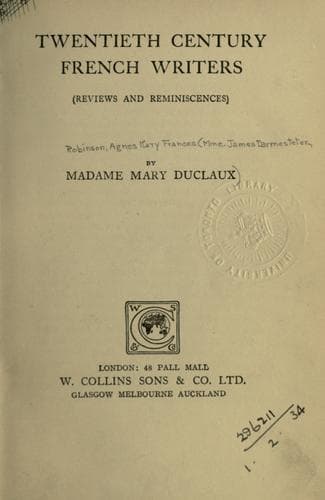
Twentieth Century French Writers: Reviews and ReminiscencesRobinson, A. Mary F. (Agnes Mary Frances)
History
Twentieth Century French Writers: Reviews and Reminiscences
Robinson, A. Mary F. (Agnes Mary Frances)
French literature -- 20th century -- History and criticism
In _La Vagabonde_, we see her as a music hall star, dropped from
the sphere of the woman of the world, and all the happier in her new
orbit, although aware she is a stranger there. Men, of course, pay
her court, and one of them, Maxime Dufferein-Chautel (whose tender,
bourgeois, authoritative nature is admirably depicted) comes very near
to being her lover, and proposes to make her his wife. But Max, good,
solid, faithful, is the least subtle of lovers--a great, affectionate
Newfoundland dog of a man. And Renée Néré, the vagabond, who has borne
so resentfully the yoke of her first husband’s heart, fears to suffer
as much from the narrowness of a second husband’s brain. She cannot
resign her liberty to an inferior, and, on the eve of their marriage,
she sends him a cruel little letter:--
‘Max, mon chéri, je m’en vais,’
and is off with her troupe on a tour to the New World.
On the first page of _L’Entrave_, she has met again with this old
lover, or rather, herself unrecognised, she has seen him pass, one
day at Nice, on the Promenade des Anglais, he, his young wife, and
his little child. He has not mourned her long! And Renée feels oddly
dispossessed: no one, nothing, belongs to her; she has no place in
the world for she is no longer a star of the stage. A convenient
inheritance has given her the means of liberty--that liberty she
coveted of old--and she strays from hotel to hotel on the Riviera
mixing with theatrical visitors, frequenting the better sort (which,
I suppose, means the wealthier sort?) of demi-monde, yet oddly out of
place among these amiable barbarians who have neither an idea nor an
ideal.
The most barbarian of all is little May, a young hetaira _à la mode_,
fresh, fair, and five-and-twenty. Renée is a dozen years older and
ought to know better; but she steals poor May’s lover away from her;
and she shackles herself with this uncultivated young man for life,
because she loves him; and it is the first time that she has loved.
Ah, she no longer asks herself: is he her equal?... Madame Colette,
like her heroine, has consented to the hobble, to the shackle, to
_L’Entrave_. She, too, has married, has found for herself again a place
in organised society, has seen open out before her unsuspected interior
horizons, and murmurs perhaps, like Renée Néré:--
‘Se peut-il, Beauté, que je te préfère l’âme qui t’habite?’
And I await her next novel with almost a tremulous expectation.
MADAME MARCELLE TINAYRE
Public-domain text, read in full here on John Shaqi.
Reviews
Reviews
No reviews yet
Be the first to share your thoughts on this work.
Elsewhere in the archive
Join the Discussion
Join the discussion
Sign in to leave a comment or review.
Sign InorCreate an account