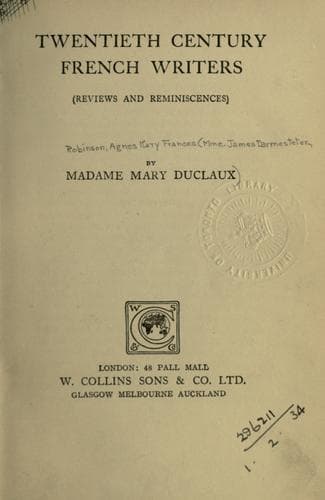
Twentieth Century French Writers: Reviews and ReminiscencesRobinson, A. Mary F. (Agnes Mary Frances)
History
Twentieth Century French Writers: Reviews and Reminiscences
Robinson, A. Mary F. (Agnes Mary Frances)
French literature -- 20th century -- History and criticism
When Madame Tinayre published her _Maison du Péché_, we thought in
France that we had discovered our George Eliot. We pitched our hopes
too high; Madame Tinayre is not even a George Sand. But she is a very
interesting and gifted novelist. If that first book was of a new and
veritable beauty, superior to any which has as yet followed it--but
Madame Tinayre is young--it is because the conception of the story
entailed a certain simplicity and order of composition, an art of
opposition and construction, a severity of style even--in fact, the
qualities in which our novelist is generally lacking. Her talent in
her subsequent works is no less rich and imaginative; but there is the
difference between a rose-tree covered with flowers trained over an
espalier, and the same lovely crimson rambler left without support, and
dropping half its fragrant burden in the dust.
Madame Tinayre, like most women writers, is endowed with an exact and
attentive faculty of observation; like very few women writers, she has
a sort of magic, similar to colour or melody, which often disguises
the poverty of her compositions; her art aspires to the condition of
music; she, too, might say with Saint Hildegard, ‘Symphonialis est
anima.’ She knows how to project, from her mind into ours, a violent,
an incomparable sentiment, as the waters in the marble fountains of
Versailles overlap and drop from one basin into another. And she has
the culture of a man.
These are great gifts, sometimes impaired by a certain warmth and
coarseness in the treatment of love,--an offence rare in male writers,
however libertine, but which hurts our taste occasionally even in a Mrs
Browning (for instance, in _Aurora Leigh_); and sometimes her fault is
a lack of measure and order which lets her books meander in a perpetual
flux, branching hither and thither, instead of moulding and rounding
them into the fore-established harmony of a perfect sphere. In brief,
Madame Tinayre is a romantic. But just once, as it were by accident,
she consented to the classic discipline. And nothing in literature is
so charming, so touching, so delightful, as a romantic who submits to
be a classic.
That ‘once’ was, of course, when she wrote _La Maison du Péché_. Her
art, so often too literal, and, as it were, photographed from reality
without arrangement (as in the greater part of _La Rebelle_), at other
moments excessive and satiating in its lyrism, found on that occasion
the exact middle path between experience and imagination. There is not
only passion in the book and beauty, but solidity, balance, meditation,
reason; there is not only spontaneity and grace, but a large and firm
knowledge of life, a perspicacity, a sincerity beyond praise. It has
the qualities of poetry and the virtues of prose.
Public-domain text, read in full here on John Shaqi.
Reviews
Reviews
No reviews yet
Be the first to share your thoughts on this work.
Elsewhere in the archive
Join the Discussion
Join the discussion
Sign in to leave a comment or review.
Sign InorCreate an account