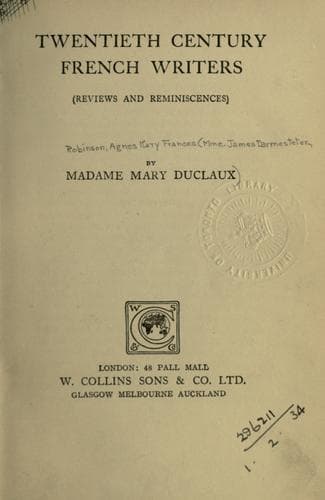
Twentieth Century French Writers: Reviews and ReminiscencesRobinson, A. Mary F. (Agnes Mary Frances)
History
Twentieth Century French Writers: Reviews and Reminiscences
Robinson, A. Mary F. (Agnes Mary Frances)
French literature -- 20th century -- History and criticism
In this novel, Madame Tinayre shows us the clash and the conflict,
the attraction and the repulsion, which cause a continual contest
between the two halves of France, equally important and irreducibly
different. Born into one of these spheres, married into the other,
Madame Tinayre is at home in either. Her Augustin, so pure and grave
and true, so narrow, so weak, so passionate, is the brother of M.
Rolland’s Antoinette, is the great-nephew of Pascal. He is a type
which has always existed in France, admirable but dangerous, for he
is incapable of understanding his contrary. Among French Protestants,
Jansenists, strict proverbial Catholics, in certain austere university
circles, there are many variations on the type of Augustin. And Fanny,
the charming Bohemian, light-hearted Fanny, an artist to the tips of
her fingers but only very dimly conscious of being an immortal soul (a
pretension which Augustin never abandons for an hour), is not Fanny
the very flower of a different, a more frivolous, a lighter, brighter
France?
The contact and the conflict of these two natures, their ill-starred,
impossible love, is all the story of _La Maison du Péché_: one of the
most moving stories of our times. There are readers, there are even
critics, who prefer Madame Tinayre’s subsequent novel, _La Rebelle_.
I have some difficulty, I admit, in catching their point of view. I
prefer not only _La Maison du Péché_, but even that exquisite piece of
still-life, _François Barbazanges_, which some have condemned on the
ground that, though it was art, it was not life. _La Rebelle_ is much
more life than art. The background, a fresco of popular Paris, is vast,
living, and exact; indeed it is too vast, too living, too exact, for it
distracts our attention from the rather ordinary characters who occupy
the foreground.
And yet there is a great charm in the drawing of Josanne Valentin, the
brave young woman-worker married to a neurasthenic invalid--that charm
of poignant sincerity which sometimes, in a woman’s work, makes the
reader’s heart beat quicker, as though he had suddenly stumbled on a
private confession. Josanne is so courageous, so tender, so kind, that
we forgive her conjugal infidelity, and chiefly regret that her lover
should be so obviously unworthy of her.
He abandons her--we knew it!--and how pathetic is the scene of their
parting--out of doors, in the street, poor Josanne encumbered with
the _filet_--the net--in which she is carrying home the materials for
the family dinner. That parting scene is unlike any other in fiction
in its heart-piercing realism! But Josanne is young, and when the
morphino-maniac of a husband (tenderly nursed to the last) departs this
life; when Josanne falls in with a high-minded radical philanthropist
of the most advanced views, we murmur, much relieved: ‘Tout s’arrange.’
Public-domain text, read in full here on John Shaqi.
Reviews
Reviews
No reviews yet
Be the first to share your thoughts on this work.
Elsewhere in the archive
Join the Discussion
Join the discussion
Sign in to leave a comment or review.
Sign InorCreate an account