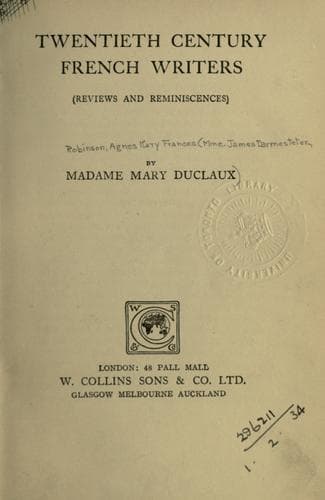
Twentieth Century French Writers: Reviews and ReminiscencesRobinson, A. Mary F. (Agnes Mary Frances)
History
Twentieth Century French Writers: Reviews and Reminiscences
Robinson, A. Mary F. (Agnes Mary Frances)
French literature -- 20th century -- History and criticism
Noël Delysle is a stronger man than Angel Clare, and proportionately
less hard and dour; but he receives the shock of Josanne’s confession
with little less dismay. He learns then that the little stepson who
will share their home--the child, he imagined naturally, of the
unfortunate Valentin--is in reality the son of Josanne’s lover. In
treating such a situation, Madame Tinayre is at her best. The central
fact of all her novels is the struggle between nature and nurture,
between instinct and convention. Deep, deep below the intellectual
superstructure, the primitive man, the primitive woman, stir in her
heroes. His virtues and tolerances fall from Noël Delysle, leaving him
jealous and passionate; her valour and self-reliance fade in Madame
Valentin, and Josanne, the rebel, becomes the merest woman.
_La Rebelle_ is an interesting book, but how much do I prefer (though
its faults he thick upon it) _L’Ombre de l’Amour_![2] The tale rambles
on as it pleases, independent of design or composition, poorly
constructed enough with its two long parallel lines, as monotonous, if
as impressive, as those low, even cliffs which enclose between their
grassy walls some Limousin or Gascon valley.
_Bis repetita placent_ is a good motto if we wish to amuse; for (as
Bergson has pointed out) there is something comic in reiteration,
in a repeated misadventure, and especially in a double fall--every
clown knows that! In spite of the rare beauty and sincerity of the
character-drawing, this tale of two pure girls stumbling, one after
the other, in the same secret slip, does produce an effect of painful
ludicrousness.
The defilement of a young girl in her innocence is the most pathetic
of themes, but it is its singularity alone that makes it touching.
Mephistopheles, in his cleverness, degrades the misery of poor Gretchen
when he observes: ‘Sie ist nicht die Erste.’ We must imagine no angel
ever tripped before; we must have very present in our sight the state
of innocence from which she is thrust out. So the wise Walter Scott
places beside his sad Effie the peerless Jeanie Deans. So George Eliot
relieves the abasement of Hetty by the pure brilliance of Dinah. But in
this novel of Madame Tinayre’s, there are but two young girls, and, by
an inconceivable error, she involves them both in the same miserable
mystery. Involuntarily we protest. I, for my part, protested, and the
novelist replied:--
Public-domain text, read in full here on John Shaqi.
Reviews
Reviews
No reviews yet
Be the first to share your thoughts on this work.
Elsewhere in the archive
Join the Discussion
Join the discussion
Sign in to leave a comment or review.
Sign InorCreate an account