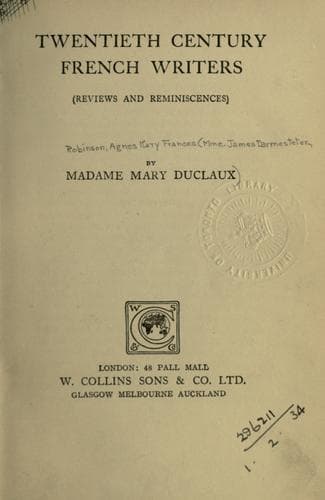
Twentieth Century French Writers: Reviews and ReminiscencesRobinson, A. Mary F. (Agnes Mary Frances)
History
Twentieth Century French Writers: Reviews and Reminiscences
Robinson, A. Mary F. (Agnes Mary Frances)
French literature -- 20th century -- History and criticism
‘Il me semble que votre principale objection porte sur le
double effet d’une double aventure, qui vous paraît un artifice
littéraire. Mais, dans ma pensée, il fallait que Fortunade
complétât Denise, que la pitié spirituelle pour le maudit aboutit
au même échec que la pitié plus physique pour le malade. Fortunade,
c’est, en tout petit, Eloa. Je crois que ces ‘doubles’ ne sont pas
sans exemples dans les grandes œuvres de la littérature, et que de
glorieux précédents auraient pu m’enhardir, si j’avais hésité. Dans
la réalité même on voit des âmes de même nature se deviner et se
rapprocher.’
The literary doubles of which our author speaks are a charming device
when the novelist treats of what is normal, salutary, or pleasant: we
love to see Rosalind by the side of Celia, or the Two Gentlemen of
Verona; but we should not care to look at two Quilps, or two Deformed
Transformed, or two Gretchens, or even two dumb girls of Portici. The
abnormal does not suffer repetition.
So I persist in my protestation, and all the more because I love
and admire the two sweet girls, so pure, so devoted; ruined and
debased, the one by pity for a man’s bodily sufferings, the other by
compassion for his moral state. For Madame Tinayre, following the
theories of Spinoza and Nietzsche, looks on pity as a debilitating
emotion, relaxing the fibres of the soul and predisposing to an ignoble
self-surrender.
But how charming is the first half of this novel; the opening scene
in the country doctor’s dining-room, with the two girls seated in the
red-paved parlour that smells of damp bricks and freshly-washed linen
and ripe apples. Denise, the young lady of the house, is the soul of a
home:--
‘A perfect woman, nobly planned
To warn, to comfort, and command----’
a large human type, as easily imagined in England or Scotland as
in Central France. But the girl who sews at her side is essentially
Limousine, her very name, Fortunade, recalls the pathetic head of the
girl-saint of the Corrèze whom she resembles--pensive and slim, with
the pursed, plaintive mouth, the suffering grace of her profile, and
the something dreamy, sweet, yet almost sullen that makes her appear
half a Gothic angel and half a scolded child.
Public-domain text, read in full here on John Shaqi.
Reviews
Reviews
No reviews yet
Be the first to share your thoughts on this work.
Elsewhere in the archive
Join the Discussion
Join the discussion
Sign in to leave a comment or review.
Sign InorCreate an account