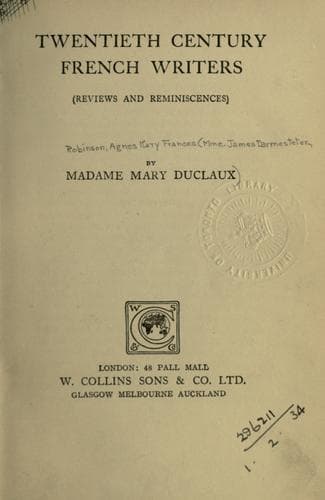
Twentieth Century French Writers: Reviews and ReminiscencesRobinson, A. Mary F. (Agnes Mary Frances)
History
Twentieth Century French Writers: Reviews and Reminiscences
Robinson, A. Mary F. (Agnes Mary Frances)
French literature -- 20th century -- History and criticism
Fortunade Brandou is only a little peasant, the daughter of the village
innkeeper, who goes out sewing by the day to the few gentlemen’s
houses in the countryside. But all the dreams, all the visions, all
the missionary fervours and superstitious fears of a Celtic race are
locked beneath the smooth black braids of her roundly projecting brow.
Her longing is not to be happy, but to expiate, to redeem, to fly to
the rescue of the oppressed. She must up and grapple with sin and
sorrow. She cannot let the evil-doer perish before her eyes. Fortunade,
with her feeble body full of suffering grace, her doleful smile, her
plaintive voice, has the soul of Corneille’s Pauline, destroying the
idols of the Temple and braving the Proconsul; has the faith and the
fervour of a Joan of Arc, letting slip her shepherd’s crook to grasp an
enchanted sword.
And, even as she must suffer and struggle for the moral welfare of
her fellow-mortals, so Dr Cayrol must needs overcome and stamp out
disease. Each of these personages is a type--complete, rare, and
living--animated with an extraordinary racial truth. In describing the
peasants and the mountain of Corrèze, Madame Tinayre puts us in contact
with her own familiar country. There are few more beautiful in France
as scenery; none more noble as a focus of human character.
Those who have studied the deep wave of moral feeling which broke
over France between the fall of the First and the rise of the Second
Empire--students of the Saint-Simonians, historians of ‘48--have
always been struck by the great proportion of men from the southern
centre--from Auvergne and Corrèze--generous, philanthropic, active
sons of Utopia, brusque and kind, avid for justice as the prophets of
Israel. These minds, less intellectually or theoretically great than
large and magnanimous, form one of the finest categories of the French
character.
In no novel have we come across so adequate a presentment of them as in
the village doctor--worthy _confrère_ of Mrs Gaskell’s country surgeon
and of Balzac’s _médecin de campagne_--the rustic _savant_, interested
in the scientific and social movement of his times yet homely in his
private tastes and standards of life; parsimonious in pence, and
liberal with his rare gold pieces; distrustful of all strangers, yet
quick to harbour a fresh chimera; prompt to anger; to all appearance
just a son of the soil, a hearty meat-fed man, fond of his glass, fond
of his pipe, fond of his gun, striding at ease in his strong solid
shoes and his old country clothes--but a sage for all that, and nearly
a saint; a man, at least, in the best sense of the word, with the root
of the matter in him. Such a man, choleric, proud, and kind, is Étienne
Cayrol, at once the hero and the father of the heroine in _L’Ombre de
l’Amour_.
Public-domain text, read in full here on John Shaqi.
Reviews
Reviews
No reviews yet
Be the first to share your thoughts on this work.
Elsewhere in the archive
Join the Discussion
Join the discussion
Sign in to leave a comment or review.
Sign InorCreate an account