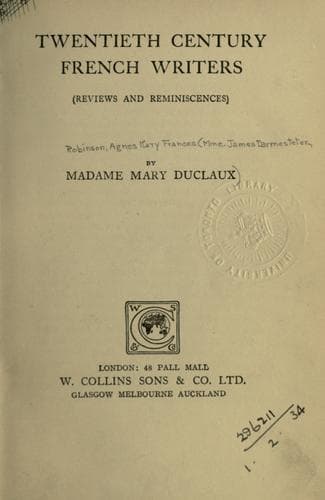
Twentieth Century French Writers: Reviews and ReminiscencesRobinson, A. Mary F. (Agnes Mary Frances)
History
Twentieth Century French Writers: Reviews and Reminiscences
Robinson, A. Mary F. (Agnes Mary Frances)
French literature -- 20th century -- History and criticism
There were two girls seated in the red-paved parlour, that smelt of
damp bricks and freshly-washed linen and ripe apples, when the doctor
strode in from the dark night outside, on the winterly evening which
opens the novel. The second is Fortunade Brandou, the little village
dressmaker, the mystic; an ill-judged pity lures her, too, to her
undoing. When Veydrenne, the poacher, the outlaw, breaks his leg,
Fortunade tends the village miscreant in his illness and strives to
save his soul:--
‘Ce serait si beau de sauver cette âme!’
Alas, when did the wolf listen to the voice of Little Red Riding Hood?
The sweet, the mystical, the charitable Fortunade fell prey to a wild
beast, and the deep gorges of the mountain torrent received the soiled,
childish body that dared no longer affront the light of the sun.
‘Morte, morte! non par le hasard d’un faux pas, non par un chagrin
d’amour, elle n’avait jamais aimé que Dieu, la chaste fille:
Dieu et ses pauvres! morte pour être allée vers celui que tous
haïssaient; morte pour avoir tenté l’entreprise folle de sauver une
âme perdue!... Perdue elle-même sans doute, brutalement outragée,
deux fois victime, elle avait payé de sa pudeur et de sa vie
l’imprudence sublime de sa pitié.’
These characters are conceived with the sure and intimate reality
that comes of kinship; we feel that Madame Tinayre is of their race
and their habitation. Here, her foot is on her native heath, and she
compels our interest far more powerfully than when she writes of Paris
(her Paris is always a little too ‘Rive gauche’); when she pictures her
Corrèze, when she evokes the mountain scenery round Brives or Tulle, I
think no French novelist since George Sand has possessed so masterly
a touch in peopling a living landscape with living beings. Indeed,
remembering the pastoral novels of Our Lady of Nohant, recalling ‘Marie
Claire,’ comparing them and this book of Madame Tinayre’s with _The
Mill on the Floss_ and _Adam Bede_, it seems to me possible that one of
the greatest gifts of woman as a novelist may lie in her singular power
of rendering country life in all the variety of its personages, its
customs, and its natural background.
FOOTNOTES:
[2] Translated into English under the title: _The Shadow of Love_.
MLLE. MARIE LENÉRU
Public-domain text, read in full here on John Shaqi.
Reviews
Reviews
No reviews yet
Be the first to share your thoughts on this work.
Elsewhere in the archive
Join the Discussion
Join the discussion
Sign in to leave a comment or review.
Sign InorCreate an account