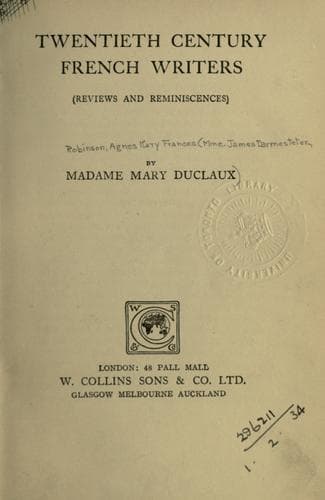
Twentieth Century French Writers: Reviews and ReminiscencesRobinson, A. Mary F. (Agnes Mary Frances)
History
Twentieth Century French Writers: Reviews and Reminiscences
Robinson, A. Mary F. (Agnes Mary Frances)
French literature -- 20th century -- History and criticism
A line from one of the essays of Suarès might serve as a motto for
all the plays of Mlle Lenéru: ‘La conscience malade, voilà le théâtre
de la fatalité moderne.’ A sick conscience, a soul diseased--in other
words, the problem of evil; or, in more modern phrase, the war between
an over-developed personality and the rights of others; such is the
theme which her genius, at once lucid and sombre, ardent and logical,
treats with a penetrating passion, with almost, as it were, a sort of
introspection, as though, in face of some grave derogation from current
morality, she had said: How did a nature, apparently excellent, arrive
at such a pass? How should I, in his place, have fallen and yet have
remained consequent with all that I was up to the moment of failure?
So that the dramas of Mlle Lenéru have the gravity and the spiritual
ardour of an examination of conscience. They seem to radiate from an
inner self full of revolt, passion, and implacable reason.
Not that Mlle Lenéru is religious. In writing this little book, it
is borne in upon me very clearly that man, not woman, is really the
religious animal. But Mlle Lenéru is not the usual free-thinker; she
is, so to speak, a theologian turned inside out. There is about her
something of the unfrocked priest who, whatever his present opinions,
feels himself always a priest, entrusted with the souls of others and
responsible for their eternal fate. She no longer accepts the promises
and the commandments of revealed religion; but nothing else appears to
her of really great importance.
In all she writes we recognise the conflict of a proud and ardent
character, a passionate and avid sensibility, with a soul enamoured of
honour, order, discipline, self-immolation; so that we never know which
is the real Marie Lenéru: the impassioned anarchist convinced that the
one important thing in life is for each individual to become the most
perfect example possible of his own peculiar type; or the ascetic,
eager to sacrifice the visible and natural life to a life invisible and
supernatural.
It is this double nature, doubtless, which gives so much substance to
the plays of this young writer. She conceals in her heart a romantic
who died young--or rather he is not dead, only buried in a perpetual
_in pace_, whence his voice sometimes issues in revolt or appeal; but
her mind is given over to the rule of a bitter and splendid reason
which assures her that neither the State, nor the family, nor any
constituted form of society, based on a firm tradition, needs genius
so much as order, passion so much as discipline, grandeur so much
as happiness; and indeed in all her plays she sacrifices (as Brutus
sacrificed his sons) the first of these categories to the second.
Public-domain text, read in full here on John Shaqi.
Reviews
Reviews
No reviews yet
Be the first to share your thoughts on this work.
Elsewhere in the archive
Join the Discussion
Join the discussion
Sign in to leave a comment or review.
Sign InorCreate an account