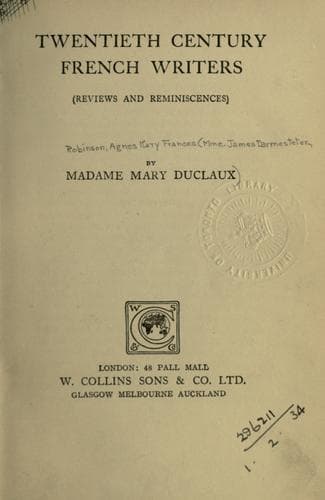
Twentieth Century French Writers: Reviews and ReminiscencesRobinson, A. Mary F. (Agnes Mary Frances)
History
Twentieth Century French Writers: Reviews and Reminiscences
Robinson, A. Mary F. (Agnes Mary Frances)
French literature -- 20th century -- History and criticism
Her sensibility remains imbued with those ideals of individualism
and ambition which reigned in France throughout the nineties: she was
born under the Consulate of Nietzsche and of Ibsen; but experience and
reflection have shown her the disasters of a moral anarchy which still
engages her sympathy though she augurs no happy issue for it. On the
frontispiece of her first book, _Les Affranchis_, she has written a
couplet from Racine’s _Titus et Bérénice_, expressing this antagonism
between the individual and his environment: two lines in which the
Jewish Queen, sacrificed by her royal lover to reasons of state
(_invitus invitam_), reminds him of his duty to himself--and to her:--
‘Rome a ses droits, Seigneur, n’avez-vous pas les vôtres?
Ses intérêts sont-ils plus sacrés que les nôtres?’
And this question resumes a theme which never ceases to occupy her
tragic sense of passion and her strong intellectual curiosity.
Her first play is the history of a grand passion in two undisciplined
yet superior natures--two super-mortals--despite society, and law, and
order. Philippe and Hélène are (as Gobineau would say) ‘Children of
the King,’ morally and intellectually a head and shoulders above the
people. By what process of reflection are they induced to sacrifice
a miraculous possibility of happiness, a draught such as they alone
might quaff, to rights and duties which they do not acknowledge? Why,
being giants, do they submit to the bonds of the pygmies? Are they
right, are they wrong in the renunciation? Is there only _one_ right
and _one_ wrong? Such are the questions raised by the history of her
_Affranchis_--her Free Souls, thus most ironically named, since, in
fact, none of us is free, and we act, not as we would, nor as we
should, but as we can.
Philippe Alquier is a philosopher, a great professor, a pioneer of
ideas, an idol of the young: in fact, a sort of Bergson, a sort of
Barrès--the Barrès of yesterday. He believes neither in duty, nor
in the moral law, nor in any Absolute, nor in any certitude; and he
discerns, in the floating relativity of things, but one obligation,
that of augmenting to its utmost his personality. He is married to a
pleasant, pretty wife, whose irritating mediocrity is, so to speak,
the hall-mark of her virtue: it is impossible to be more respectable
than Marthe. In the early Twentieth Century, at the dissolution of
French monasteries, Alquier, the philosophic anarchist, receives under
his roof his wife’s sister, Mother-General of the order of Reformed
Cistercians, Abbess of Fontevrault.
Public-domain text, read in full here on John Shaqi.
Reviews
Reviews
No reviews yet
Be the first to share your thoughts on this work.
Elsewhere in the archive
Join the Discussion
Join the discussion
Sign in to leave a comment or review.
Sign InorCreate an account