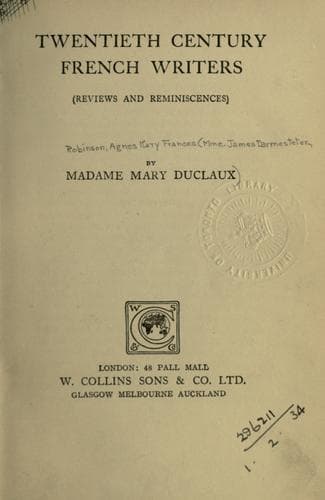
Twentieth Century French Writers: Reviews and ReminiscencesRobinson, A. Mary F. (Agnes Mary Frances)
History
Twentieth Century French Writers: Reviews and Reminiscences
Robinson, A. Mary F. (Agnes Mary Frances)
French literature -- 20th century -- History and criticism
France, on the other hand, is self-sufficing, almost self-supporting,
and always has been so. If we consider the Duke of Berry’s _Book of
Hours_ we realise that in many parts of France the business of life
has continued almost unchanged since the Fourteenth Century. From the
pruning of the vine in February (our month of March) to the fattening
of the swine in the oak-woods in November, while the wood-cutters mark
the trees for felling, here are just such scenes as the dweller in
rural France has constantly before his eyes to-day, unaltered--scenes
which the accumulated associations of countless generations have
invested with a human interest more poignant, more intimate, than any
which mere landscape can afford. And we admire the French peasant; his
frugality, his industry, his endurance are indeed beyond all praise;
his economy is marvellous, and such is his good humour that he makes
a pleasure of his self-denial; miserably lodged, poorly fed, he is
conscious of no inferiority; he knows himself to be the backbone of
France.
The peasant and the landscape for ages have remained unchanged.
France is so large a country, with so great a variety of soil and
climate, that there are all sorts of French peasants: materialistic,
clean, bright, and gay, in Touraine and the Charentes; superstitious,
poverty-stricken, imaginative, in Vendée and Brittany; good-humoured,
ambitious, and positive in Auvergne--and so on through all the nations
of France. When you knew the place, you knew the peasant--until quite
lately. The ‘regionalist’ (the provincial) novel has come into being
just when the field labourer himself has ceased to be regionalist, or
provincial; for military service is a wonderful leveller and unifier.
Until the middle of the last century (until, that is to say, the
days of George Eliot in England and the latter days of George Sand in
France), a Fourteenth-Century peasant might have revisited his country
parish almost anywhere in France, and have noted little alteration to
mark the flight of time. The last fifty years have made more difference
in rural matters than the five centuries that went before them. The
dairy farms of Normandy with their patent separators, their ferments
for cheese flavours, sent down in neat little tubes from the Pasteur
Institute; the arable lands with their great red, throbbing mechanical
sowers, reapers, binders, automatic ploughs, threshing machines, etc.;
the network of roads with their motor-cars and bicycles; the train
whirling past in a white puff of smoke behind the screen of poplars;
such homely sights of our everyday Twentieth Century would cause a
mediæval husbandman to open his eyes considerably.
Public-domain text, read in full here on John Shaqi.
Reviews
Reviews
No reviews yet
Be the first to share your thoughts on this work.
Elsewhere in the archive
Join the Discussion
Join the discussion
Sign in to leave a comment or review.
Sign InorCreate an account