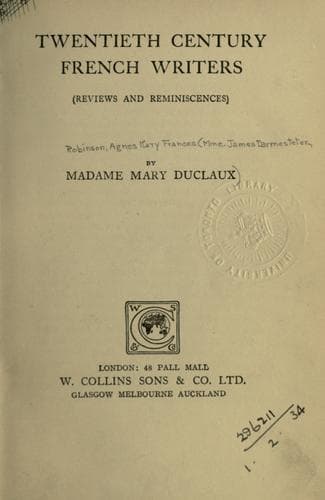
Twentieth Century French Writers: Reviews and ReminiscencesRobinson, A. Mary F. (Agnes Mary Frances)
History
Twentieth Century French Writers: Reviews and Reminiscences
Robinson, A. Mary F. (Agnes Mary Frances)
French literature -- 20th century -- History and criticism
He would have to seek the depths of Brittany, the heart of the
Cantal, the wastes of the Lozère, to find some faint image of the
world he knew. There, indeed, save for the frequent crops of potatoes
and buckwheat, which he would not recognise, he would find little
changed; the one-toothed wooden plough still scores its furrow on the
steep hillside; the thud of the flails is loud in the dusk of autumn
evenings; in the fields the women stoop and gather the buckwheat into
stooks and bind it standing, even as the reapers cut the stalks from
the ground; the old pastoral life continues, not greatly changed for
better or for worse. But even here the century-old country life of
France is menaced, and that threat hanging over it renders it more
dear, and almost sacred, that the rural novel in France is at once more
exact and more tender in its record than it was in the century gone by.
When I came to live in France in 1888, there was a pastoral novel
of course--there has always been a pastoral novel in France, as I
said--but it was of a most calumniatory and reviling sort. Great was my
surprise, when I spent my summers in the country, to find that the old
gaffers on the farms were _not_ left to die of hunger and neglect when
they could no longer work, but, on the other hand, were treated with
the utmost honour and consideration, given invariably the best seat on
the settle, the best wine, expensive tonics from the doctor’s shop, and
all that filial kindness could devise. Maupassant’s wonderful stories,
Zola’s _La Terre_, must evidently have some foundation in fact. But my
personal experience has not corroborated their pessimism.
Then, after the pastoral novel _genre rosse_, came, with the very last
years of the Nineteenth Century, the reign of the social novel; and,
as a matter of course, the pastoral novel followed suit. The best
stories of those times, I think, are René Bazin’s, especially that
most picturesque and touching idyll of a farm in Vendée gradually
destroyed by the rural exodus, _La Terre qui Meurt_. In _Donatienne_,
the same writer paints the poverty of a Breton village, and the
temptation--almost the dire necessity--which induces the young mother
to quit home and children in order to earn the large wages, and live
the facile days of a wet-nurse in Paris. And, naturally, he shows the
moral (and finally the material) ruin which follow on that ill-judged
step.
In _Le Blé qui Lève_ (The Growing Corn), René Bazin describes
the life of the woodland labourers--the foresters, wood-cutters,
charcoal-burners, and so on--who form an important part of the rural
population in France; and he shows them ravaged by strikes, syndicates,
etc.; for M. Bazin is nothing if not Catholic and Conservative.
Public-domain text, read in full here on John Shaqi.
Reviews
Reviews
No reviews yet
Be the first to share your thoughts on this work.
Elsewhere in the archive
Join the Discussion
Join the discussion
Sign in to leave a comment or review.
Sign InorCreate an account