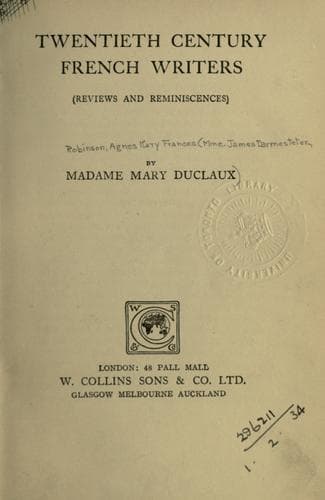
Twentieth Century French Writers: Reviews and ReminiscencesRobinson, A. Mary F. (Agnes Mary Frances)
History
Twentieth Century French Writers: Reviews and Reminiscences
Robinson, A. Mary F. (Agnes Mary Frances)
French literature -- 20th century -- History and criticism
This keen appreciation of the beauty and character of Nature, combined
with a tragic sense of the aimlessness and incertitude of human
destiny, are the peculiar quality, I think, of the closing Nineteenth
Century: a mingling of enchantment and disenchantment. Nowhere, of
course, is it so remarkable as in Pierre Loti, but he is out of our
perspective--which only concerns the Twentieth Century. We have
noticed it in Jules Renard, only lately dead (1864-1909). We shall
find it again, with less artistry and a more poignant pity, in another
writer, ten years younger, who died about the same time, Charles-Louis
Philippe; as we found it in Madame Colette.
Jules Renard was one of the rare French authors of our time who do
not scorn to love their calling; who are men of letters from the
bottom of their soul, and not principally apostles, or disciples,
or reformers, or philosophers;--who are as happy as Flaubert when
at last they enclose an aspect of reality, however humble, in some
perfect phrase as pure as the amber which preserves a fly. Renard
had ideas and passionate convictions of his own; to resume, let us
say that they were the exact opposite of the ideas and passionate
convictions of a Paul Claudel; but he did not usually write to express
or to expound his peculiar theory of anti-clericalism or democracy.
If these opinions came into the picture, he noted them with his
customary poignant exactitude, no more. Only once did he think of
writing a play with a purpose. His great, his scrupulous endeavour
was to represent reality as he saw it, just as it struck his shrewd,
short-sighted gimlet-glance, his Japanese or Alexandrian sense of
detail; but an endless patience--the patience of the sportsman and the
painter--enabled him to track an impression down to its most secret
touch. And then he fixed it in one perfect phrase--sometimes just
marred by too tense an effort to seize an evanescent reality. Jules
Renard, in fine, was an artist.
He looked at Nature, not as so many do, from the fourth floor of a
Paris boulevard, but from the village street or from the field that
slopes away beyond the orchard hedge. He was mayor of the little
commune in the department of the Nièvre where he spent so much of his
time--and a mayor passionately absorbed in his municipal affairs; but
when he turned homewards and sat down to his writing-table, Chitry-les
Mines and Chaumont lost their magic; the man, the mayor, gave place to
the patient artist--surely the most scrupulous of our time--carving his
cherry-stone, polishing his bead of amber, where some chance insect
lives for ever in a pellucid incorruptibility.
Public-domain text, read in full here on John Shaqi.
Reviews
Reviews
No reviews yet
Be the first to share your thoughts on this work.
Elsewhere in the archive
Join the Discussion
Join the discussion
Sign in to leave a comment or review.
Sign InorCreate an account