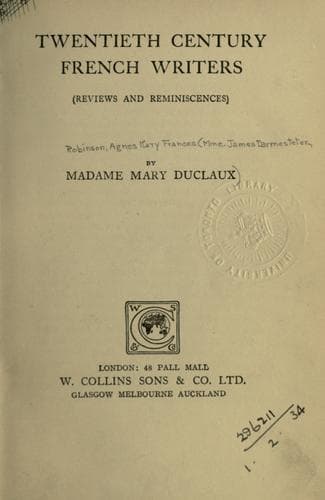
Twentieth Century French Writers: Reviews and ReminiscencesRobinson, A. Mary F. (Agnes Mary Frances)
History
Twentieth Century French Writers: Reviews and Reminiscences
Robinson, A. Mary F. (Agnes Mary Frances)
French literature -- 20th century -- History and criticism
This love of detail, this desire to reproduce a landscape, an object
or a personage in its individual, intimate truth, are points of contact
between Renard and another novelist from the same centre of France:
Charles-Louis Philippe. But Philippe’s eyes were less keen and his
heart was far more tender: Philippe was, as it were, steeped in the
Russian pity of a Dostoievski. And he knew the poor and the miseries
of the poor, not as an artist knows them, mingled with romance, but as
the child of poor people who has felt such things at first hand.
He was born in 1874 at Cérilly, a little town of the department of the
Allier, where his father was a maker of wooden shoes. A pupil of the
board school, his rare abilities promised a prosperous future, and,
gifted for mathematics, he studied for the school of engineering--for
‘Polytechnique.’ But his frail health and tiny size rendered him inapt
for that profession, and his livelihood seemed a problem too difficult
to solve when Maurice Barrès, a Deputy for Paris, recommended him for
a small post in the pay of the town council at the Hôtel-de-Ville.
Philippe was thenceforth an inspector of stalls and shop-fronts--and
his kind protector chose for him the VII. arrondissement of Paris,
the Faubourg Saint-Germain, where stalls are few. In return for his
nine guineas a month (230 francs) Philippe had but to stroll about
the quiet, almost provincial streets of the old-fashioned courtly
quarter and reap the harvest of a quiet eye. But Philippe’s vision was
chiefly interior. In the noble Rue de Varenne and the historical Rue
Saint-Dominique he contemplated that abyss of misery, that slippery
Avernus of women’s lazy wiles and young men’s dangerous desire, which
he has revealed to us in _Bubu de Montparnasse_ and _Marie Donadieu_:
tragic idylls of the distant Latin quarter.
Here we seem as far as may be from the pastoral novel! But Philippe, in
Paris, saw rise upon his inner eye the Cérilly of his childhood; the
one-storied house, opposite his father’s shop, where the Père Perdrix
lived with his old wife; and the lonely cottage, capped with thatch,
where little Charles Blanchard lived alone with his mother, the widowed
charwoman, and where the poor, dull, dreamy, ill-nourished lad died at
nine years old--of ‘old age.’ And he saw his own house and his childish
self, and his adorable clever mother, and all the poem of their love.
And he wrote _Le Père Perdrix_, and _La Mère et l’Enfant_, and he began
_Charles Blanchard_. And then, at five-and-thirty years of age, he died.
He cannot be said to have lived in vain, for the young inspector of
stalls left behind him, not only a great name to a little clan--a clan
which included Barrès, André Gide, Daniel Halévy, Valéry Larbaud,
André Beaunier; that is to say, whatever is most delicately critical
in France--but also a school. The chief names in that school are Émile
Guillaumin and Marguerite Audoux, both of them, like Philippe, natives
of the Bourbonnais.
Public-domain text, read in full here on John Shaqi.
Reviews
Reviews
No reviews yet
Be the first to share your thoughts on this work.
Elsewhere in the archive
Join the Discussion
Join the discussion
Sign in to leave a comment or review.
Sign InorCreate an account