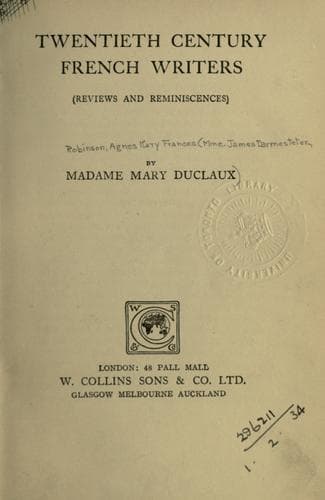
Twentieth Century French Writers: Reviews and ReminiscencesRobinson, A. Mary F. (Agnes Mary Frances)
History
Twentieth Century French Writers: Reviews and Reminiscences
Robinson, A. Mary F. (Agnes Mary Frances)
French literature -- 20th century -- History and criticism
There are, in the literary world of Paris, those who do not scruple
to assert that Madame Audoux’s great pastoral novel, _Marie-Claire_,
was in reality written by Charles-Louis Philippe. I wonder if those
inconsiderate critics can have read either author! It is as though
one should accuse Baudelaire of having written the country novels
of George Sand; as though one should say that Thomas Hardy really
wrote Tennyson’s _Idylls of the King_. The incomparable simplicity
and serenity of _Marie-Claire_ are as different as may be from the
difficult harmony, the obscure, subtle, poignant intuitions of
Philippe. It is true that Philippe was gaining in simplicity (perhaps
from his contact with Madame Audoux?) when he died. And no doubt he
was prodigal of counsel, aid, and precept to the little dressmaker who
was his pupil in letters: he showed her, perhaps, in a novel, how to
‘cut out.’ But their genius, their experience, their character, and
even their view of life is quite distinct: the one infinitely minute,
tormented, tragic; the other large, quiet, and serene; either equally
sincere.
It was Madame Audoux who called the friends--the ardent, devoted
friends--of Philippe to the nursing home in the Rue de la Chaise, where
he lay dying of typhoid fever; it was she, with his mother, summoned
from Cérilly, who received his dying breath; and he had often spoken in
his circle of the noble imagination, the just and luminous elegance of
mind which distinguish _Marie-Claire_. So that when the book appeared
there were friends to greet it--the friends of poor Philippe, dead in
his grave.
But the book did not need these protectors, for its success was
immediate, popular, immense, and by no means purely literary; readers,
who had barely heard of Philippe himself, of André Gide, of any of
Madame Audoux’s literary clan, opened her volume in their thousands.
The story has been translated into several languages--into English,
I think. No doubt it owed something to Mirbeau’s eloquent preface,
revealing the author’s personality. The public is sentimental; it was
touched by the picture of the poor little dressmaker--not a princess of
tape and scissors, but one of those little snips who go out to ladies’
houses, working for half a crown a day. The account of this poor woman,
no longer quite young, suddenly threatened with blindness if she pursue
her trade; turning then, for a consolation, as much as for a means
of livelihood, to literature, and with her first venture discovering
herself a great artist; this poignant history seemed to the public a
novel before the novel began.
Will Marguerite Audoux, intimidated by this rare success, remain
the woman of one book? I hope not! If she dare not again attack the
pastoral novel, let her write the touching life of her friend and
master, Philippe. Or let her turn from the fields of France to the
moving story of a woman alone in Paris, earning the right to live as
she draws an interminable thread.
Public-domain text, read in full here on John Shaqi.
Reviews
Reviews
No reviews yet
Be the first to share your thoughts on this work.
Elsewhere in the archive
Join the Discussion
Join the discussion
Sign in to leave a comment or review.
Sign InorCreate an account